Tuesday, September 14, 2010

Change by Drew Ginn (11 Jun 2007)

Change by Drew Ginn (11 Jun 2007)

[..] When I think of change and in particular the change the is require for any athlete to go from ok to great, it is them and their coaches who take the critical steps that are all to often considered to risky.

That is what change is.

It’s taking a risk, and it’s letting go and facing the challenges that need to be confronted.

The examples are everywhere and they are ever changing themselves and with every rise and fall it is understood to be a natural part of the process.

So to all who are willing to change the rewards are without limit. If though the thought of stepping into the unknown scares you well you may as well [leave] , because there is no smooth static path.

We need to move, we need to adapt, and we need to change if we are to realise what’s possible when you take that leap of faith.


Another great post from Drew Ginn. There are lots of points in this one. I have just drawn this one out for now. A couple more to follow which seem relevant based on recent experiences.

Back to this one. Lots of changes have occured already with plenty more to come. I have always accepted change, though the first steps are always hard. As Drew says we need to let go, [..] move, adapt [..] change [.. and] take that leap of faith.

The road to Tampa2011 started today. Happy to have made a decision and it's now a risk I want to take. Not sure how far I will go, but need to start somewhere. Let the Climb begin.

[Addendum: Self-delusion and self-loathing Posted by Seth Godin just after I posted the above. Might be something in what he writes. For me, there could be a bit of both there, and probably more of one than the other :-)]

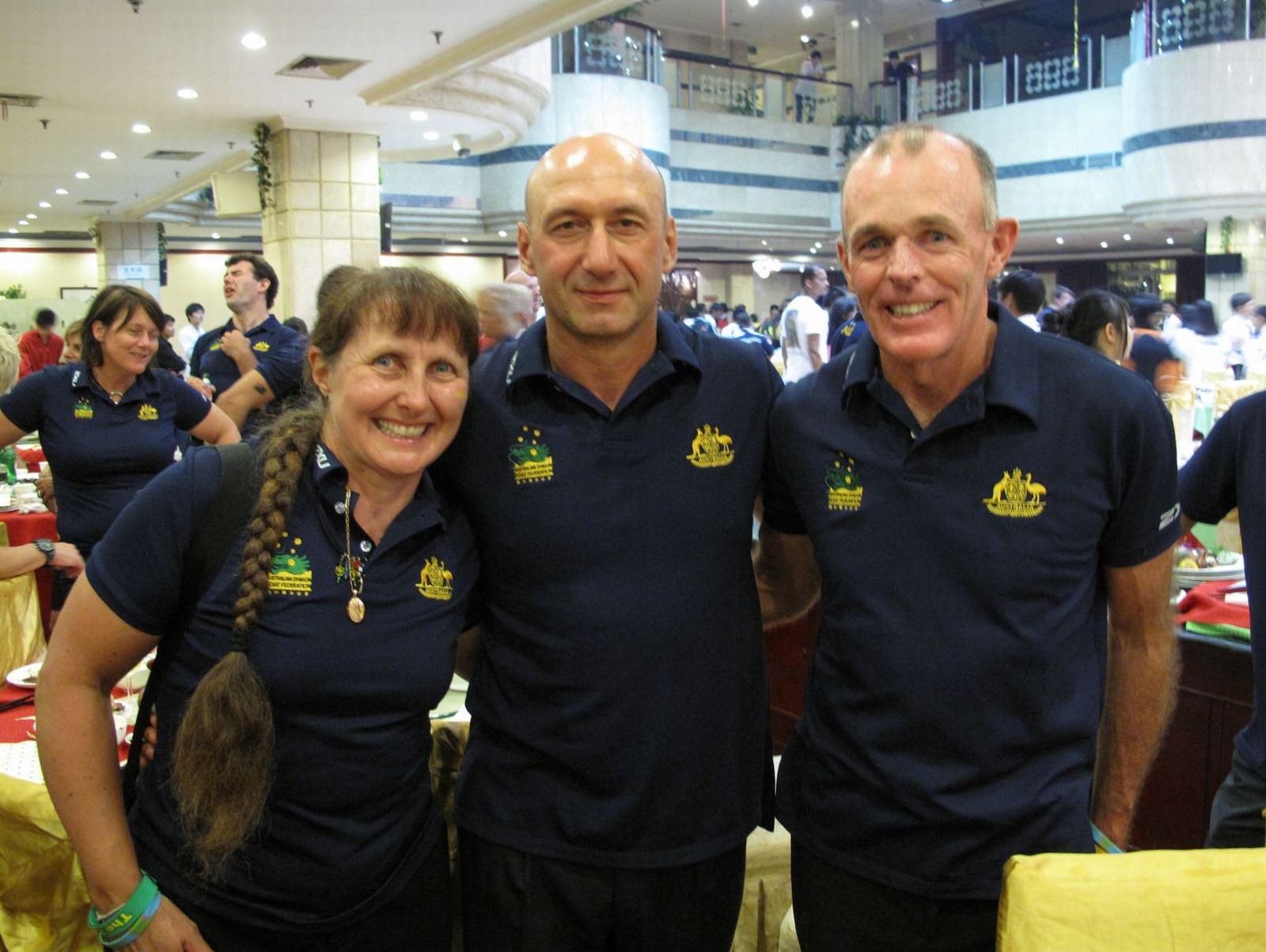
Joanne, Serge and Geoff - Wujin/China - Sun 2 May 2010

Wednesday, September 8, 2010

The Climb - Our Main Range Summit Challenge

The Climb - The Main Range Range Summit Challenge

Dragons Abreast Ausrtralia Seminar
Cancer Council Queensland
Tuesday 31st August, 2010

Next is a little story that covers another aspect of Jenny’s Life – our annual trip to the Snowy Mountains and our Main Range Mt Kosciuszko Summit Challenge.

The Colorado Trail is just short of 500 miles in length. Doug Miller spent a summer (approximately 60 days) hiking the trail. In August 2009 he was diagnosed with Cancer.

A few months into his journey with Cancer, he wrote about the lessons he had learnt on the Colorado Trail and how they paralleled the lessons learnt on his journey with Cancer.

I read his story a few months after Jenny had passed away. It resonated with me and I could relate to it, in particular the following quote:
"A single step repeated hundreds and thousands of times would see us eventually arrive at the end.

It did not take superhuman strength or a talent that most do not have. It took a steadfast commitment.

Step by step, the miles added up and the challenges slipped by. Today just like those days on the trail, is another step.

Tomorrow is yet another.

I walk this journey in anticipation of the end, but I also know that there is much to learn in the process.

It is the process, no matter what the hardship where great beauty and adventure can be found."

Doug Miller on the Colorado Trail

Around New Year, for the last 11 years we have travelled to the Snowy Mountains area, around Perisher Valley and Jindabyne, to get away from the holiday crowds, to relax and take in the sights of the Snowy Mountains.

Each year we would also take the opportunity to challenge ourselves to the 22km Main Range Summit walk, to not only witness the beauty of the mountains, but to test ourselves and to benchmark our fitness to the previous year’s effort. This was particularly important for Jenny as she, and we also, could see what effect her cancer and treatment was having on her physical body, for the previous 12 months.

Some years were easy, while others were more challenging, particularly the long and steep uphill leg from the Blue Lake to the Summit of Mt Kosciuszko.

One of the more difficult years for Jenny was January 2008 when a side-effect from one her treatments, which caused soreness and tenderness of her feet (Hand-Foot Syndrome), made it very difficult for her to walk even a few steps. This did not stop her and she did the 22km walk, one painful step at a time. We were so proud of her, though, in typical Jenny style she thought it to be nothing unusual or out of the ordinary.

On the first day of 2009, we did the Main Range walk, for what would turn out to be our last time together. While temperatures in Sydney were the typical balmy 30's, the weather in the Mountains had turned and there was a wind chill factor of minus 15 C. This was our last chance to do the walk. We had tried a day earlier, but were not prepared for the cold. This time we were prepared, with Jenny and Joanne wearing seven layers, as well as beanies and gloves. We decided to at least walk the first 6 km to the Blue Lake and make a decision there whether to continue on for the next 16km or return.

For all of us, the conditions were challenging. However, for Jenny there were extra challenges which revolved around dealing with the many issues relating to her cancer, the most obvious for this higher altitude challenge, being the tumors in her lungs. Little did we know at that stage the cramping in her stomach she had experienced over the previous month or so, would be the early signs of countless tumors in her liver, which would be diagnosed in early March 2009. On top that, was also the embryonic stages of a tumor in her brain, which would manifest itself as a 4cm tumor in early June 2009.

This was definitely the most difficult Main Range challenge for us all, Jenny in particular. She was short of breath, even on the small downhill sections. As we reached the Blue Lake, we rested quite a while and we left it up to Jenny to decide what we should do. Eventually, she said she felt she could do it, so off we nervously set, in very strong head winds, to the Summit. We stopped at Lake Albina on the way.

Every step was a struggle for Jenny and she did amazingly well to make it to the Summit of Mt Kosciuszko. As usual we would take our Summit top photos - this time there was no one there (usually there would be 20-30 people) as we had taken twice as long as normal and we had reached the Summit hours after everyone had headed back to their starting points.

When I read the little story from where the leading quote comes from, I thought of Jenny initially, and later Joanne and myself.

I think it has helped me understand, that we were not only doing this walk each year (with each year being a "step") for the beauty and physical challenge of the Mountains, but also for the beauty that can be found in the "process" of doing something like this each year.

It also helped me appreciate Jenny’s approach to life, her journey with cancer and how she embraced it to live a wonderful and fulfilling life, and to achieve her dreams.

I think it also helps me appreciate the difficult "steps" that Joanne and I take each day, without Jenny's physical presence in our lives - but knowing we are "getting on with life" with the support of our family and friends, and knowing many great experiences and adventures lay ahead for us and those in our lives.

We did the Main Range Summit walk this year, on the 1 Jan 2010 (more here). Jenny was with us every step of the way.

Just another little story of perseverance and determination from Jenny. Jenny guides and inspires us from above.

In closing, we would like to take the opportunity to thank Dragons Abreast. It has provided many opportunities for Jenny, Joanne and I. We are grateful for the experiences in life Dragons Abreast has presented us. We encourage you to embrace these opportunities and experiences also.

The Climb - Power Point Slides (pdf)

The Climb - Power Point Slides (pdf)

The Climb - Power Point Slides (pdf)
Tuesday, September 7, 2010

The Climb - Jenny's Amazing Climb

The Climb - Jenny's Amazing Climb

The Climb - Jenny Petterson (Video)

Dragons Abreast Ausrtralia Seminar
Cancer Council Queensland
Tuesday 31st August, 2010

Dragons Abreast Sydney is not only just about paddling. They also have a craft group which Jenny and Joanne attended regularly. After Jenny’s passing, the Craft Group organised a beautiful scrap book album (see picasa) with contributions from the dragon boat community which included photos and memories. We have a copy (see picasa) of it here today if you would like to look at it in more detail at the end of the session.

We have put together a small video of the pages from the scrap book album with music from an inspiring and appropriate song titled “The Climb” by Miley Cyrus (lyrics and video).

As can be seen by our annual trip to the mountains, the climb can be taken quite literally. It can also be a metaphor for other journeys through life. It could be your paddling journey, it could be your journey with an illness, it could be the journey of Dragons Abreast Australia and its members.

Anyway, this video represents Jenny’s Climb and is a tribute to Jenny, the Dragon Boating Community and in particular Dragons Abreast Australia who provided the opportunities for Jenny's AMAZING CLIMB..

Monday, September 6, 2010

It's whoever has worked the hardest and smartest who will win - Anders Gustafsson (Sun 22 Aug 2010)

Anders Gustafsson (twitter) World Champion Kayaking K1 500m 2010 (youtube - Tweet)


Anders Gustafsson - K1 500m - 2010 ICF World Championships - Poznan/Poland - (Sun 22 Aug 2010)


A transcription of the video follows:

Anders Gustafsson (twitter): Hi, this is Anders Gustafsson. Tomorrow I will leave for the [2010] World Championships in Poland.

It's been really [difficult] training here in Sweden leading into the World Championships.

This is a pretty normal day (very windy and cold). Can't say it has been the best.

All my time trials have been really slow. That wont affect me too much. I will still go to Poland with a strong heart.


A flashback to the 2009 World Championships:

Commentator: 7/100 of a sec. That was the difference between Gustafsson and the German Rahue at the finish. And the Swedish settle for another silver this world championships.

Anders Gustafsson (twitter): Yesterday I was so happy over my Silver. But today I can't help to think about how close it was. Sadly I didn't win.

I'm stoked but still what little extra fuel to work even harder. I will try to make sure next time that I will be the best. I want to be world champion.

It's a huge difference in being 2nd in the world and being world champion.

I dream about the day when I can say that I am world champion.

I still think about the close race in 2009 sometimes.

I get over it by working even harder and to try and make sure that next time I have the inches on my side.

And in kayaking it's not luck that decides who wins.

It's whoever has worked the hardest and smartest who will win.


At the end, we go back to Anders in Sweden before leaving for Poland.

Anders Gustafsson (twitter): This has only made me harder and tougher and hopefully that will show in the race in Poland.

Full Capacity by Drew Ginn (23 May 2007)

Full Capacity by Drew Ginn (23 May 2007)

[..] It is amazing to put everything into a single stroke.

So when I refer to full capacity I know it can relate to fatigue but on this occasion it was about maximum force.

It was as if I was producing peak force every stroke and what becomes noticeable is when I cam off the boil just slightly.

The difference between sitting on 1.34 and 1.35 is so fine and yet full capacity is in reality maybe not sustainable.

So what I was playing with was going to full capacity and then staying aware of how I was producing that force.

Relaxation and breathing were key and speed of movement was critical.

Once I started to find I began working hard it was like being presented with a choice. A fork in the road, with one option being to muscle it and try to work harder and harder or the other was to relax into it and trust that by keeping the intention of speed, relaxation and by using a strong breathing rhythm.

Well a couple of times I went down the path to option one and a few times down the path to option two. The result was clear to sustain the output and ease of drive was actually possible with the later.

So stepping up to full capacity is one element in the equation to optimal performance, the other being the ability to sustain the intensity.

It was a great little test and I will keep in mind during our preparation for the Worlds this year.


Another Favourite Blog Post from Drew Ginn.

A nice follow on from the previous post - One Stroke (29 Apr 2008) by Drew.

Dragons Abreast Sydney (DAS) - Full Capacity - CNY 2005 - Feb 2005


Dragons Abreast Sydney (DAS) - Full Capacity - Woronora Regatta - Dec 2004

Saturday, September 4, 2010

Photos: Venice Graffiti (Sep 2009)

Red - Graffiti/Venice - Sep 2009 (picasa)


Wake Up Italy - Graffiti/Venice - Sep 2009 (picasa)


Recently noted that I was surprised by the amount of Graffiti in Venice. Did a little searching and found this post - Strange Geographies: Venetian Graffiti (30 May 2010) - by Ransom Riggs where he writes:

One thing that surprised me about Venice was that graffiti was everywhere. There’s almost as much art on the streets as there was in churches and museums [..] once I stopped being offended I started being fascinated. While the oil-and-canvas masterworks hanging in the city’s galleries may reflect of Venice the Renaissance era, it’s what’s painted on the outside of the museum wall that reflects what Venetians — at least the ones wielding cans of spray-paint — are thinking now.

One Stroke by Drew Ginn (29 Apr 2008)

Gondala/One Stroke - Venice - Sep 2009 (picasa)

One Stroke by Drew Ginn (29 Apr 2008):

[..] So what is it to be engaged fully in that one stroke?

After the fact it is difficult to isolate the experience of one stroke from the others. It is challenging to gain clarity on exactly one stroke because it happens in a flow of many more. [..] the dilemma is not just identifying the one, but ensuring it is pure and uncontaminated by the past one’s and future one’s.

The joy of performing the one stroke and immersing in it is challenged by the accumulated nature of the cyclic or repeated experiences. [..]

[W]hat is it to be fully engaged in one stroke[?] Knife-edge comes to mind. [..] the sense of being on a knife-edge is a great description. Less so from the perspective of balance or even match up, it has an essence that finds a cord within that is about effort, ease, maintenance and fatigue.

In fact to see it clearer I notice that the one, perfect one that I see is one of edgy contrast.

It is in a position of precarious, pointedness with a subtle oscillation between more than one element and more then one stroke including the past, present and future.

The elements involve self, team-mates, equipment, water, movement, harmony, mismatch, load, flow, hardness, relaxation, sequences, positions, focuses, emphasis, location, energy, strain, surge, comparison, connection, separation, isolation, effort, ease, understanding, knowledge, risk, exposure, confidence, doubt, poise, purpose, clarity, mistakes, errors, forgiveness, acceptance, love, joy, fear, ambiguity, tension, dynamics, leverage, struggle, difference, compliments, coaching, thoughts, distractions, intentions, actions, results, exchange, change, habits, confusion, satisfaction, uncertainty [..]

One stroke is so hard to describe, I know it when I feel it and some times I know it when I see it. Maybe the one is not perfect but we make it so because we like the idea of it being better than it really was.

The experience of rowing fascinates me because it has so many things it relates too. What I do know is that when I am engaged things change. The world looks and feels different and it gives me hope. Giving in to it, but not letting it get the better of you is critical. That may sound strange but there is something about being part of the boat, the movement, the other person, and the surroundings that makes so much sense of everything. [..]

Accessing the moment is not just about rowing, but I find it palatable to articular the action of rowing in a way that means something. One stroke at a time is a cliché and like one shot at a time it has meaning if you connect with it in some way. [..]

One stroke then is like every other stroke and they in turn they are like the days of life we live. It is just an experience how I choose to judge it or them is my choice. Years ago I watch a video the Searle Brothers made about their 1992 Olympic Games success in the coxed pair. In the video Greg spoke of a simple activity they did which involved calling out better or worse as a measure for each stroke they rowed. The idea I guess was to have more, better strokes and as such you develop accountability and improvement.

One stroke means different things and the reasons are varied. What enables full engagement in one stroke or in the moment is also varied. [..] One stroke unfolds and expands. Its meaning is huge and the vastness of experience is inspiring. Being at one in one is the art to rowing I suppose which really isn’t anything new, but repeated. So you see, like me, a cliché can mean so much which it does. [..]

Another Favourite Blog Post from Drew Ginn. A truly amazing description of rowing[/paddling] and as is usual with Drew's writings I can relate to in many ways.

I always find the strokes from the start to transition are the easiest to remember. Darren calls them the "glory strokes" and in many ways they set the boat up for the rest of the effort. Get it right and you are on the way. Get it wrong and you are on the back foot trying to recover. Can also remember some lift calls in various efforts over the years.

Love the description of 'Knife-Edge' and 'Edgy Contrast'. I often feel that when the effort is such that things seem to be edgy, that is where we need to be. Always wary of that that perfect feeling.