I recently found a copy of the following speech that Jenny had drafted just after being told she had multiple tumors across her liver. Shortly after sending it to me, Jenny was told that the Meeting had been postponed and the speech would be rescheduled to a later date. Sadly, Jenny did not have the opportunity to present the speech as she passed away on the Tue 30 Jun 2009. She was looking forward to giving the speech, as Jenny and Joanne's Mother, Margaret, had been a member of the neighbouring Miranda Legacy Group.
After finding the email with the Speech, I read the speech again and I was pleased to reread the sections on the National Breast Cancer Foundation (NBCF) towards the end of the speech (here). Jo and I have been working with the NBCF over the last few months to help with their XMAS Fund Raising Campaign (here) which will help fund the work of Professor Matt Trau's Research Team's work into the early detection of the spread of secondary cancer.
It is nice to be reminded that Jenny was aware of his team's work and we know she would have fully supported being involved in the fund raising campaign (Jenny's Story). I have annotated the speech with photos from Jenny's Power Point Presentation.
Geoff - 23 Nov 2010Cronulla Legacy Meeting
Monday 16th March, 2009
Jenny Petterson
"Cancer is something that people do not expect to happen to them and no matter who is diagnosed, and at whatever time in their life, it is a shock"
Jenny Petterson - Rainbow / Byron Bay - Oct 2007 (picasa)Thank you everyone for having me. The
National Breast Cancer Foundation has raised an enormous amount of funds for use into breast cancer research and I will detail the three biggest projects later in my speech.
Cancer is something that people do not expect to happen to them and no matter who is diagnosed, and at whatever time in their life, it is a shock which has huge ramifications for not only the person involved but also their family and friends. It takes a lot of adjustment to get used to.
 Family Photo #1 - Camilla Gardens / Caringbah - Jan 1991 (picasa)
 Family Photo #2 - Japenese Restaurant / Neutral Bay - Apr 2003 (picasa)
 Family Photo #3 - Thomas' Birthday - Bronte - Jun 2003 (picasa)
We have been involved with
Dragons Abreast Australia for about 8 years now. I will talk about how I came to be involved with Dragons Abreast later but firstly I will begin with my personal story with breast cancer.
 Jo and Jenny - Dragons Abreast Sydney - Blackwattle Bay / Sydney - 2004 (picasa)
 Dragons Abreast Sydney - Blackwattle Bay / Glebe - May 2004 (picasa)
 Dragons Abreast Sydney - Darling Harbour / Sydney - Feb 2006 (picasa)
My first association with breast cancer was when I was seventeen years old and studying for my HSC. My Aunty who had just turned fifty at the time she was diagnosed with breast cancer. Back then I had no understanding of the terms primary cancer or secondary cancer and the significance of the difference between these terms. Sadly my aunty passed away three years after her initial diagnosis.
 "My Aunty who had just turned fifty at the time she was diagnosed with breast cancer."
Aunty Elsie, Jenny, Joanne - Cronulla (picasa)Seventeen years after my aunty’s diagnosis, I was told at age thirty four that I too had breast cancer. This was a complete bolt out of the blue as I had always been extremely healthy and played a lot of sport.
 Jenny and Joanne - 100m Hurdles - Sylvania Waters - 197? (picasa)
 Little Athletics - Pagewood (picasa)
 Little Athletics - Pagewood (picasa)
I initially had a lumpectomy but the pathology indicated that all the cancer had not been removed, so the following week I underwent a mastectomy and removal of all lymph nodes under my arm. I had a reconstruction at the same time. My prognosis was excellent. There was no lymph node involvement and I needed no further treatment. I went back to work and my life just carried on normally.
 Jenny - Post Surgery - Hurstville Community Hospital - Apr 1997 (picasa)
 Margaret and Jenny - Post Surgery - Hurstville Community Hospital - Apr 1997 (picasa)
That was until nine months after my initial diagnosis when my mother was diagnosed with ovarian cancer. Her situation was extremely serious requiring chemotherapy to reduce the size of the tumour before surgery. The next sixteen months were a real roller coaster ride for my mother with chemotherapy followed by more surgery and then more chemotherapy.
 Jenny, Margaret and Joanne - 1998 (picasa)
 Joanne, Margaret and Jenny - Port Macquarie - May 1998 (picasa)
It was during this time that my mother, my twin sister Jo and I took up meditation as a way of helping ourselves in addition to what the medical community were offering us. The three of us all had very positive attitudes but the meditation also seemed to give us peace of mind. Our father had passed away six years earlier. Our meditation teacher was amazing and helped us through many difficult periods that followed. We had the opportunity to meditate in the centre of Australia at Uluru which was a very empowering experience.
 Margaret, Jenny, Ian Gawler and Joanne - Ian Gawler Foundation / Victoria - Jan 1999 (picasa)
 Jenny, Joanne, Margaret and Norm - Parliament House / Canberra - 1988 (picasa)
 Joanne, Barbara and Jenny - Uluru - Dec 1999 (picasa)
Due to our strong family history of hormone related cancers we were referred to the Prince of Wales Hereditary Clinic for genetic testing. I also have an uncle with prostate cancer and a cousin with breast cancer. While initially there was no conclusive evidence of the common breast cancer gene some variances are currently being investigated and Jo undergoes regular checkups every six months as we are identical twins.
 Joanne and Jenny - Pompidou Centre / Paris - 26 Aug 2005 (picasa)
 Jenny and Joanne - Darling Harbour / Sydney - Feb 2004 (picasa)
 Family Photo - Kirrawee / Sydney - Aug 2006 (picasa)
During that same period I received the news that I had a local recurrence within the scar tissue. This was removed and I then began a six week course of radiotherapy and six month course of chemotherapy. My mother and I were undergoing chemotherapy at the same time.
 Jenny, Margaret and Joanne - Port Macquarie - May 1998 (picasa)
 Jenny, Margaret and Joanne - Miranda - 1998 (picasa)
Unfortunately as is so often the case with ovarian cancer, it is very advanced before it is diagnosed. My mother had a real battle on her hands but she put up a very strong, courageous fight. Jo and I had the honour of caring for her at home for eight weeks until sadly she was succumbed by the disease.
 Margaret - Miranda - 1998 (picasa)
Four months after my chemotherapy was finished I was diagnosed with secondary cancer in my lungs. There were at least ten tumours across both my lungs and it was inoperable. The situation was extremely serious. My oncologist advised me to give up my job and do something that I really enjoyed. I didn’t go back to work but rather concentrated on getting better. That was nine years ago.
 Jenny, Jodie, and Joanne - Darling Harbour / Sydney - Feb 2007 (picasa)
 (picasa)
 Dragons Abreast Sydney - Woronora - Dec 2004 (picasa)
Three months after my lung tumours were diagnosed I got engaged. Geoff and I were married ten weeks later. It looked like I may have needed more chemotherapy and I didn’t want to get married with no hair so we fast tracked the arrangements. As it turned out I didn’t have any chemotherapy at that stage. I started on hormone therapy which involved a daily tablet and monthly injections at the hospital.
 Joanne, Tim, Geoff, Jenny, David and Jenny (picasa)
 Sylvania Heights - 30 Mar 2000 (picasa)
 Jenny and Geoff - Sylvania Heights - 30 Mar 2000 (picasa)
It was at one of those monthly visits to the hospital that I noticed an advertisement for
Dragons Abreast Australia. This was a group of breast cancer survivors and supporters who paddled a dragon boat for fun, fitness and to raise awareness of breast cancer. It sounded like the perfect sport for Jo and I. We joined our local club Port Hacking, because at that time there was not a branch of Dragons Abreast in Sydney. It was fantastic. To get out on the water in the early morning when it is so still and quiet and to paddle was exhilarating.
 Dragons Abreast Sydney - Darling Harbour / Sydney - Feb 2006 (picasa)
 Dragons Abreast Sydney - Woronora - Dec 2004 (picasa)
From this time on our lives changed. We would go to regattas and paddle with the Dragons Abreast ladies from all over Australia. It wasn’t about competition but rather about having fun and making new friends with other ladies who had walked a similar path and really understood what you had been through.
 Dragons Abreast Australia - Darling Harbour / Sydney - 2006 (picasa)
CT scans showed that the tumours in my lungs had reduced to one solitary tumour. Then, at the beginning of 2003 one of my regular CT scans showed that this tumour was increasing in size and there were another two tumours. The advice was to wait for three months and see what happened as they were slow growing. The next CT scan was to reveal something totally unexpected – a large tumour in my abdomen as well as a growth in the size of the lung tumours. I commenced a course of chemotherapy under a clinical trial.
 Chemo - Joanne and Jenny - St George Cancer Center - Jul 2003 (picasa)
 Jenny - Blackwattle Bay / Glebe - Jun 2003 (picasa)
 Jenny - St George - Jul 2003 (picasa)
 Jenny - St George Hospital - Aug 2003 (picasa)
As I was a survivor I was eligible to paddle in the Dragons Abreast Challenge at the coming World Championships in Shanghai in 2003. We started to think how could Jo get to compete at this event. Firstly, we thought she could learn to sweep. However, while we were coming into the off-season here, there would be no regattas where she could gain the appropriate experience to sweep overseas. Then, we were lucky enough to hear how NSW were trying to set up a selective team to compete at the Nationals in Adelaide. It was a long shot but we thought that it was worth a try. There was a chance that if Jo qualified in the NSW team and they were successful at the Nationals, then they would become the team to represent Australia and that way we would both get to paddle in Shanghai.
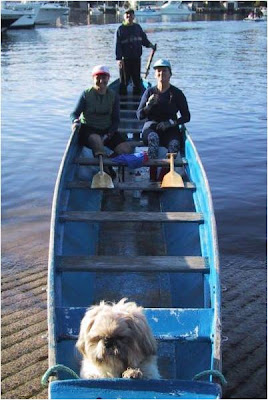 Joanne after practicising Single Dragon Boat Water Trial ('That's Gizzie in Seat 1') - Port Hacking / Sydney - Jul 2003 (picasa)
Well Jo made it into the first selective NSW team. They won at the Nationals and training began for the Shanghai campaign. But things didn’t work out as planned. China was faced with the SARS crisis. The World Championships were cancelled in Shanghai and moved to Poznan in Poland. The Australian team were well into their training and decided to compete in Poland. The Dragons Abreast team decided not to go to Poland and in the meantime I had been quite sick and was unable to travel.
 2003 Australian Dragon Boat Team - Poznan Bound - Sydney International Airport (Aug 2003) (picasa)
In the lead up to Poland I would go out to Penrith every month and video the team. The footage was used by the coaches to analyse the paddling technique of the team. Just seeing all these fit people inspired me to get over my chemotherapy and get back in the dragon boat.
 Jenny with the Video Camera - Sydney International Airport - Australian Team Departure - Aug 2003 (picasa)
The next year in 2004, I decided I would train really hard and try out for a spot on the NSW team. I felt I had nothing to lose and didn’t want to have any regrets and think down the track “I wonder whether I would have made it or not?” Well I made it into the NSW team and competed at the National Championships. Following a win there Jo and I represented Australia at the World Championships in Shanghai. We had finally made our dream of competing in Shanghai. This time we were both competing for Australia. Jo won a bronze medal in the Australian Premier Mixed Team.
 Australian Masters Women's Dragon Boat Team - Shanghai - Oct 2004 (picasa)
 Australian Masters Women's Dragon Boat Team - Shanghai - Oct 2004 (picasa)
 Australian Premier Mixed Dragon Boat Team - Shanghai - Oct 2004 (picasa)
 Joanne - Australian Premier Mixed Dragon Boat Team - Shanghai - Oct 2004 (picasa)
 Australian Premier Mixed Dragon Boat Team - Shanghai - Oct 2004 (picasa)
 Joanne - Australian Premier Mixed Dragon Boat Team - Shanghai - Oct 2004 (picasa)
The following year Geoff, Jo and I competed at the World Championships in Berlin. Jo and I competed together in the Australian Premier Women’s Team and Jo was also the coach for the NSW and Australian Masters Women’s Team.
 Australian Masters Mixed Dragon Boat 500m Team - 2005 IDBF World Dragon Boat Championships - Berlin - Fri 05 Aug 2005
I am monitored on a regular basis and the CT scan I had at the beginning of 2006 showed that the remaining tumour in my lung had grown and there was another tumour there. I underwent some more chemotherapy and a four week course of radiotherapy on my lung.
I kept up my training with both of my oncologist’s encouragement and was part of the NSW team in 2006. Jo and I were joint coaches for the NSW Masters Women Team and we competed at the National Championships in Nagambie, which is a small town in country Victoria. NSW went very well and won the right to represent Australia at the Asian Dragon Boat Championships in Macau in September of that year.
 Jenny and Joanne - NSW Masters Women's Coaches - Nagambie / Victoria - Apr 2006 (picasa)
I had the honour of carrying the Australian flag at the opening ceremony.
 Jenny - Australian Dragon Boat Team - Opening Ceremony - Asian Dragon Boat Championships - Macau / China - Sep 2006 (picasa)
 Jenny - Australian Dragon Boat Team - Opening Ceremony - Asian Dragon Boat Championships - Macau / China - Sep 2006 (picasa)
The Australian team went really well and finished third overall behind China and Macau. The women’s team of which I was a member of won a bronze medal in the 500m. It was such an emotional time when we all came off the boat after the race and it was confirmed that we had come third. The day before we had been beaten by a fraction of a second by Chinese Tapei into fourth place and we all wanted to win a medal so much. It was such an amazing experience standing on the podium wearing the green and gold Australian tracksuit watching the Australian flag being hoisted up the flagpole next to the Chinese and Macau flags.
 Bronze Medalists - Australian Women's Dragon Boat Team - Macau - Sep 2006 (picasa)
 Bronze Medalists - Australian Women's Dragon Boat Team - Macau - Sep 2006 (picasa)
 Sylvia and Jenny - Macau - Sep 2006 (picasa)
Less than two months before we were due to head off to Macau my implant had ruptured. I was very fortunate to have it replaced quickly to allow me to get over the surgery and back to training before we left for Macau.
 Joanne, Jenny and Geoff - St George Private Hospital - Aug 2006 (picasa)
On our return from Macau a routine CT scan showed that I had an accumulation of fluid around my lung. I had it drained so I was able to take part in the
Hawkesbury Canoe Classic. This is an 111 kilometre race from Windsor to Brooklyn along the Hawkesbury River. All types of craft including kayaks, canoes, outrigger canoes and surf skis take part in the race. It was a fantastic experience. I was a member of a six person team who paddled an outrigger canoe. Geoff and Jo were also in the team. We set off at 6pm and paddled through the night arriving 13 hours later. It was such a great experience under a sky filled with thousands of stars.
 Joanne, Jenny and Geoff - Hawkesbury Canoe Classic 2006 - Windsor - Sat 28 Oct 2006 (picasa)
 Pacific Dragons Crews and Supporters - Hawkesbury Canoe Classic 2006 - Windsor - Sat 28 Oct 2006 (picasa)
 Jenny and Joanne - Hawkesbury Canoe Classic 2006 - Windsor - Sat 28 Oct 2006 (picasa)
 Sunrise - Hawkesbury Canoe Classic 2006 - Hawkesbury River - Sun 29 Oct 2006 (picasa)
 Sunrise - Hawkesbury Canoe Classic 2006 - Hawkesbury River - Sun 29 Oct 2006 (picasa)
 Team Happy - Geoff, Jenny, Mandy, Jo, Nicci and Paul - Hawkesbury Canoe Classic 2006 - Brooklyn - Sun 29 Oct 2006 (picasa)
The fluid again filled up in my lung cavity so I had it drained before the time trials for the NSW team selection for the 2007 team to give me a better chance. I made it into the team along with Geoff and Jo.
The fluid began building up again so it was time to fix the problem permanently. In February I underwent an operation where my lung was glued to the lung cavity.
 Jenny - Lung Operaton - St George Private Hospital - Feb 2007 (picasa)
Over Easter the National Dragon Boat Championships were held at Penrith. NSW earnt the right to represent Australia at the World Championships in a number of categories including the ones that Geoff, Jo and I were involved with. Competition was really close. For the first time ever the World Championships were held in Sydney.
 NSW Masters Women's Team - Penrith / Sydney - Apr 2007 (picasa)
 NSW Masters Women's Team - Penrith / Sydney - Apr 2007 (picasa)
 NSW Masters Women's Team - Penrith / Sydney - Apr 2007 (picasa)
Then in April after we had the place to compete in Sydney a CT scan revealed I had a tumour in my liver. They were retrialling for the Sydney team on the Sunday and what I was really concerned about was would I be okay to trial. I was okay and I did the best trial I have ever done and confirmed my position in the team.
I underwent a liver resection where they removed 20 percent of my liver. Three weeks later I needed to have my gall bladder removed because it had died as a result of the liver surgery. I was so lucky that my spot in the team was held open for me. My doctors were so helpful in getting me the treatment quickly and getting me back in the boat as soon as they could. I started another course of chemotherapy and had one cycle before the World Championships and the rest after.
 "I underwent a liver resection where they removed 20 percent of my liver."
Jenny - Liver Resection - St George Private Hospital - Jun 2007 (picasa) Jenny - Liver Resection - St George Private Hospital - Jun 2007 (picasa)
It was the most successful World Championships Australia has ever competed at. Jo and I won a silver and a bronze medal in the Masters Womens and Geoff won three silver medals in the Masters Men. Jo and Geoff also won bronze medals in the Masters Mixed.
 Joanne and Jenny - World Dragon Boat Championships - Penrith - Sep 2007 (picasa)
 Joanne, Geoff and Joanne - World Dragon Boat Championships - Penrith - Sep 2007 (picasa)
 Australian Masters Dragon Boat Tema - World Dragon Boat Championships - Penrith - Sep 2007 (picasa)
The weekend after the World Championships was
Dragons Abreast Australia regatta on the Sunshine Coast in Queensland. This was fantastic with over 1,600 breast cancer survivors from all over Australia, Canada, USA, New Zealand and Italy competing.
On returning from Queensland, bone scans then revealed the cancer had spread to my bones. At the beginning of 2008 I had two weeks of radiotherapy on my sacrum, head and lower right leg. I got over this quickly and got back in the boat for the Chinese New Year regatta.
 International Dragons Abreast Festival - Kawana / Queensland (picasa)
 Geoff, Jenny, Don McKenzie and Joanne - International Dragons Abreast Festival - Kawana / Queensland (picasa)
 Joanne, Michelle and Jenny - International Dragons Abreast Festival - Kawana / Queensland (picasa)
We were then starting to train for the World Club Crew Championships in Penang this year. The World Club Crew Championships is different to the World Championships in that it is the best clubs that compete, in your club uniform, rather than a selective crew competing as the Australian team. My whole upper body just swelled up overnight. I didn’t know what was wrong and didn’t associate it with the cancer. As it turned out a lymph node in my chest was pushing on the main vessel to the heart and it had caused a clot to form. Lucky for me it didn’t completely block it off as this is where all the blood drains from the top half of the body. Another course of chemotherapy followed. The drugs caused my resting heart rate to be raised so I couldn’t train while having the chemotherapy. As soon as I was finished with the chemotherapy and had the relevant heart tests I was back in the boat to try and build up for Penang. This was a great regatta and we managed to place 4th which was very exciting. There were about thirty of the best club crews from around the world in each category.
 Jenny and Joanne - Penang - Club Crew World Championships - Aug 2008 (picasa)
 Pacific Dragons - Penang - Club Crew World Championships - Aug 2008 (picasa)
A scan showed that the tumour in my lung has started to grow so I had some more radiotherapy and bracchi therapy. This is where a wire is connected from your nose into your lung and radiotherapy is injected.
Last week a scan showed that the cancer has spread right through my liver. I start a new treatment on Thursday which involves chemotherapy and a new drug which stops blood systems being setup for new tumours.
We have been training hard for the Nationals this year. Last week it was confirmed the night I received the liver news, that I had made it into the A team. My doctor’s advice was that I could keep training while undergoing treatment.
 Jenny and Joanne - NSW Outrigger Sprint Titles - Penrith (picasa)
 Pacific Dragons - Outrigging Canoe Race Ettalong - Jan 2007 (picasa)
We train three sessions a week in a dragon boat, two sessions in an outrigger canoe, do three weight sessions at the gym and at least three cardio sessions. The great thing is that Geoff, Jo and I get to train together.
 "The great thing is that Geoff, Jo and I get to train together."
Jenny, Geoff and Jo - Macau / China - Sep 2006 (picasa) Pacific Dragons - Australian National Dragon Boat Championships - Apr 2007 (picasa)
A number of things have helped me through my cancer journey.
- I have a fantastic team of doctors and medical professionals that do so much to help me. When something is worrying me I know they really listen and do something to help me immediately,
- I look forward to any treatment offered to me as another step towards conquering this disease. Whenever I go for chemotherapy I never think "I wish this chemo course was over", I think "Great, here is another opportunity to get rid of the cancer".
- Over the past few years I have had a number of hospital stays. I look at these as time that my body needs to have a rest. I find them very relaxing and as Geoff’s says when I am packing my bag to go to hospital That’s right, you’re off on holidays".
- I have always said to all of my doctors "Don’t give me a prognosis". I believe the mind is very powerful and I don’t want it locking onto any sort of timeframe. My mother was of the same opinion and she didn’t want her doctors to put any time constraints on her life. I am not silly, I know my situation is serious as through my associations with cancer support groups I have seen others with a similar diagnosis to me not be so lucky. But everyone’s journey is different. Each time I see a new doctor I say up front Don’t give me a time.
 Greg, Joanne, Jenny and Jodie - Darling Harbour - Feb 2005 (picasa)
 Paul, Jenny and Joanne - St George Private Hospital - Jul 2004 (picasa)
 Joanne, Dr Horton and Jenny - St George Private Hospital - Jan 2007 (picasa)
- I am a member of the Sutherland Shire Cancer Support Group. It is made up of the most amazing bunch of people. The members have all been involved in either their own or a family member’s cancer journey so they understand where each other is coming from. There are lots of laughs in the group as well as sad times but everyone is always there for everyone else.
 Geoff, Jenny and Doug - Sutherland Shire Cancer Support Group - Daffodil Day - Sylvania - Aug 2000 (picasa)
 Sutherland Shire Cancer Support Group - Daffodil Day - Sylvania - Aug 2000 (picasa)
 Sutherland Shire Cancer Support Group - Daffodil Day - Sylvania - Aug 2000 (picasa)
- And finally, last but not least, is Dragons Abreast Australia. This organization has given me so much to live for. As you have heard, it inspires me on, whenever there is a bump in the road.
 Sutherland Shire Cancer Support Group - Sutherland Relay for Life - May 2003 (picasa)
 Sutherland Shire Cancer Support Group - Sutherland Relay for Life - May 2003 (picasa)
 Sutherland Shire Cancer Support Group - Sutherland Relay for Life - May 2003 (picasa)
 Sutherland Shire Cancer Support Group - Sutherland Relay for Life - May 2003 (picasa)
I became involved with the
National Breast Cancer Foundation through
Dragons Abreast Australia. They were setting up a Speakers Bureau and were looking for breast cancer survivors who may be interested in helping them out. I am not a person who would normally volunteer to do public speaking but I felt the work of the National Breast Cancer Foundation was so important that I would like to help out. The Speakers Bureau puts a human face on breast cancer and the research funded by the
National Breast Cancer Foundation.
 NBCF Pink Ribbon Magazine Launch - Darling Harbour - Oct 2004 (picasa)
The
National Breast Cancer Foundation is a not-for-profit, community funded organization responsible for funding research into all aspects of breast cancer research. Research is from the laboratory, to the bedside, and beyond.
The
National Breast Cancer Foundation was founded in 1994. Since this time there has been a rise in the survival rate despite the fact that more people are diagnosed. This is because treatment has improved through research. Detection has increased, public awareness has increased and research has increased. Long term investments have made improvements but there is still a big improvement to be made, and that is to find the cause and cure for breast cancer.
 Joanne, Marie Bashir and Jenny - Sydney Breast Cancer Foundation - Pink Ribbon Lunch - 12 Oct 2004 (picasa)
The
National Breast Cancer Foundation has recently announced three five million dollar projects. It is the first time in Australia that this level of funding has been committed to breast cancer research. For someone currently fighting breast cancer this was very exciting and inspiring.
The latest project is a collaboration between the Federal Government and the
National Breast Cancer Foundation. They have each contributed 2.5 million dollars. It is a project with BreastScreen initially in Victoria, but then all over Australia where people 50 – 69 years will be asked questions on lifestyle, exercise levels and diet. The National Breast Cancer Foundation will start a similar survey with people of all ages. This will create a huge database and is the first situation around the world where researchers will have information before the breast cancer has been has been developed. Anyone down the track, who finds they have breast cancer will be asked to give tissue samples.
 Geoff, Angela and Jenny - Sydney Breast Cancer Foundation - Pink Ribbon Lunch - 12 Oct 2004 (picasa)
The other two new long term projects involve almost 40 researcher from a range of sciences. They are collaborative projects and the experts say that large scale collaborative projects will greatly reduce the time to find the answers for breast cancer.
One of these projects involves creating a new detection technology that may be as easy as a blood test. Using nanotechnology and molecular genetics, this technology would have a major impact on early detection, and treatment of advanced breast cancer patients. Researchers from NSW and Queensland will be working on this project.
 One of these projects involves creating a new detection technology that may be as easy as a blood test.
Professor Matt Trau - Brisbane / Uni of Qld (picasa)The other project involves studying the body’s nuclear receptors to discover and fast-track information to help with prevention, new treatments and boosting existing treatments.
 Jenny, Petria Thomas and Joanne - 2004 NSW Sports Awards - Feb 2005 (picasa)
 Geoff, Jenny, John Eales and Joanne - Sydney - Sep 2006 (picasa)
Joanne, Jenny, Michelle and Caroline - Australian Story 10th Anniversary - ABC Studios / Ultimo / Sydney (picasa)
Jenny and Joanne - Australia's Biggest Loser - Dec 2007 (picasa) Patricia, Janice, Bert, Jenny and Joanne - Family Fued - Aug 2006 (picasa)[Geoff: Jenny would normally finish her speech with the following bolded dot points. I have added this section because I would have suggested that to her when finalising the speech (this was only the first draft). To me it was always the best bit of her speeches as it showed us how she chose to live her life. ]In finishing if I can offer some suggestions which have helped me through the past twelve years:
- keep a positive attitude,
- live each day one at a time but do set goals for yourself,
- surround yourself with positive, supportive people,
- take time for yourself, and
- do something with your life that you really enjoy.
I feel I am so lucky and have a wonderful life. I have had some great opportunities through breast cancer to meet some very inspiring people. Geoff and Jo have been a constant source of support for me. Breast cancer has totally changed my life but for the best.

Jenny, Geoff and Joanne - St George Private Hospital - 19 Aug 2006 (picasa)Thank you .. Jenny
 Jenny - Coffs Harbour - 25 Dec 2005 (picasa)
Jenny's Speech as
pdf.
Jenny's Overhead Powerpoint Presentation as
pdf.


