Showing posts with label Technique. Show all posts

Saturday, July 5, 2014

On Technique - Kirk Tuck (Thu 03 Jul 2014)

Born to Run (*) - London Tube / London (Fri 09 Aug 2013)

Kirk Tuck (*) writes On Technique (*):
In swimming [or running (*), paddling (*), etc] it seems that good technique (*) is everything. Endurance (*) and strength (*) is important but it's all trumped (at least in sprints) by better technique (*). Which requires constant practice (*) and focus (*).
via Independence Eve Swim. With camera in tow. (*) by Kirk Tuck (*).

Thursday, December 19, 2013

On Training and Discipline - Siegfried Hansen / Eric Kim Street Photography (Wed 18 Dec 2013)


Untitled - Pitt Street / Sydney (Wed 18 Dec 2013)

Siegfried Hansen (*) writes On Traininng (*) and Discipline (*):
There are many things you learn by training (*) and discipline (*), but overall you should internalize both theory (*) and technique (*) to a point that you can fully concentrate (*) on the moment when taking pictures. I navigate through [..] my hometown, almost blindly (*) on certain routes, focusing on things that are happening around me. It’s all coincidental, nothing is preset.
via Capturing Harmony on the Streets through Graphical Images: Interview with Siegfried Hansen (*) by Eric Kim (*).


Untitled (Detail) - Pitt Street / Sydney (Wed 18 Dec 2013)

Sunday, December 19, 2010

Dragon Boat - Technique Video (Sun 12 Dec 2010)

Peri's Boat - Left (Sun 12 Dec 2010

Peri's Boat - Right (Sun 12 Dec 2010

Paul's Boat - Left (Sun 12 Dec 2010

Paul's Boat - Right (Sun 12 Dec 2010

Rob's Boat - Left (Sun 12 Dec 2010

Rob's Boat - Right (Sun 12 Dec 2010

Wednesday, December 15, 2010

Manny Vincent on Outrigger Canoe Technique - bapuiii (05 Nov 2010)

Manny Vincent on Outrigger Canoe Technique - bapuiii (05 Nov 2010)

Had a few Outrigger Canoe Technique Videos here lately - Kamini Jain and Johnny and Danny Ching. Everyone has their own way and I think they are all trying to get the same kind of message across. Learn and enjoy.

Monday, November 15, 2010

Mastering the Blending of Outrigger Canoe Steering Techniques

"To master the blending of steering techniques, a certain amount of inherent feeling is necessary. Knowing how the canoe will react in different conditions, feeling movements before they occur and anticipating corrections before they happen, need to be natural. Letting the canoe flow instead of fighting to remain straight, is critical. The canoe can move up 10 degrees off its mark at any time without being off course. You need to let the canoe find its way - you are only there to help it get there"

Jim Foti (Page 96) - Outrigger Canoeing: The Art and Skill of Steering.

A great little book. Many thanks to Rachel for giving me a copy. Plenty to learn from this recently revised edition.

Thought of the above quote when out in the thick of it yesterday. Some challenging conditions for all crews. We all survived and had a great time in the process. Definitely a massive learning experience for us all, me in particular.

Had a few Stall Outs - need to work on a strategy to fix this up in such big conditions. We had a lot water in the Canoe at the end. GPS to follow.

Thanks to Michelle for the fantastic photos from yesterday's Outrigger Canoe (OC6) Regatta at Five Islands/Wollongong.

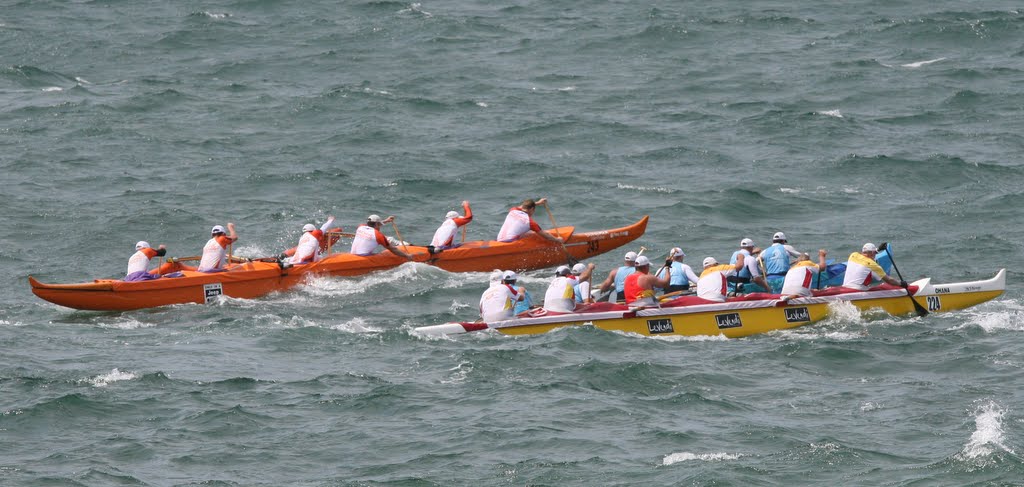
Pacific Dragons Mens Crew (From Seat 1: Mark Hall, Graeme Bacon, Stuart Young, Peter McAlister, Grant Billen and Geoff Eldridge) - Five Island OC6 Regatta - Sun 14 Nov 2010 (picasa by Shell)

Pacific Dragons Mens Crew (From Seat 1: Mark Hall, Graeme Bacon, Stuart Young, Peter McAlister, Grant Billen and Geoff Eldridge) - Five Island OC6 Regatta - Sun 14 Nov 2010 (picasa by Shell)

Pacific Dragons Mens Crew - Five Island OC6 Regatta - Sun 14 Nov 2010 (picasa by Shell)

Pacific Dragons Mens Crew - Five Island OC6 Regatta - Sun 14 Nov 2010 (picasa by Shell)

Pacific Dragons Mens Crew - Five Island OC6 Regatta - Sun 14 Nov 2010 (picasa by Shell)

Pacific Dragons Mens Crew - Five Island OC6 Regatta - Sun 14 Nov 2010 (picasa by Shell)

Pacific Dragons Mens Crew - Five Island OC6 Regatta - Sun 14 Nov 2010 (picasa by Shell)

Back in the Harbour - Pacific Dragons Mens Crew (Geoff Eldridge, Grant Billen, Peter McAlister and Stuart Young) - Five Island OC6 Regatta - Sun 14 Nov 2010 (picasa by Shell)

Back in the Harbour - Pacific Dragons Mens Crew (Stuart Young, Graeme Bacon and Mark Hall) - Five Island OC6 Regatta - Sun 14 Nov 2010 (picasa by Shell)

Monday, November 9, 2009

Feel the Boat

I really enjoy steering an OC6 and I often find myself steering an OC6 at my regular training sessions. I try to pickup useful tips from the various Outrigging web sites - ausoutrigger.com and ocpaddler.com. Found the following question and responses very informative.

Ender writes on the ocpaddler forum:

"I paddle OC-6 and my coach suggested I work on feeling the boat. [..] Honestly I really have no idea what he is talking about so I just keep paddling hoping one day the mystery will be solved. Any clues?"

When I steer an OC6, in certain sections, I ask the crew to feel the water. Anyway, some nice responses to this question and the whole discussion is worth reading. For me, the following response by Hiro C. resonates the most:

"when sitting in a car or a plane, you can close your eyes and you can fell when it goes faster or slower, you can feel if it is turning. In the canoe, try to get focused on those feelings. You should feel when a wave is pushing or pulling the canoe. You will feel when it’s gliding and when it’s not."

Port Stephens Changes Race - 29 Mar 2008

Monday, March 9, 2009

[oc6] Open Water Turns

More great advice from Another View from Seat 6 (available as a word doc here) by Jerry Franklin, this time on open water outrigger race turns:

Turns often provide a challenge during the races. The rule states that any inside boat that has overlap (i.e., has any part of the canoe ahead of any part of a leading canoe) has the right of way [1]. The reality is that unless you know and have confidence in the other canoe’s steersman and can communicate with him/her, it is not worth taking the risk of hitting and getting tied up with another boat even if you have the right of way. You may win a protest if the other boat doesn’t give way, but the boats that pass you from behind while you are trying to get untangled will still finish ahead of your boat, and the boats ahead of you will get further ahead.

You can’t control everything that will happen in a race turn, but you can plan what you are going to do in advance (and, I mean, way in advance). By checking the boats around you and determining where they are likely to be when you hit the turn, you can plan where you want to be and begin setting up your position long before the turn. Turns are of different angles and take place in a variety of conditions so there is no one perfect way to execute all turns. Where the turn is fairly severe (i.e., a course change of close to 180 degrees), a wide approach with a tight exit works well. But each turn calls for a somewhat different approach and exit, and other boats entering the turn at approximately the same time will determine your best angle of entry and exit. [2]

Notes
  • [1] Knowing and having experience with other steersmen is important. The good ones will work with you to avoid problems. Sometimes that might give you a little advantage, sometimes it will give them a bit of an advantage, but it will always help both boats/crews in the long run. Remember, part of being a good steersman is staying out of trouble and sometimes that means working in cooperation with other steersmen.

  • [2] In my experience, most steersmen try to turn the boat too sharply thus slowing it down and having to correct severely to straighten out at the end of the turn. I prefer a less severe turn which keeps more boat momentum and lets the boat more naturally come to the correct course. However, if the crew is concerned that the boat is not coming around fast enough, they may try to “help” it turn when it actually would be better for them just to paddle forward and let the boat turn on its own. They need to know what you are doing or trust you to do the right thing.
A little incident recently made me fully understand this rule as it was intended - the key word is overlap. I thought for some reason the inside canoe had to be ahead (ie it's nose was in front of the outside canoe).

Alan Q. - Five Islands OC6 Regatta - Wollongong - Sun 18 Jan 2009

Friday, March 6, 2009

Steering an Outrigger Canoe in the Wind

Another View from Seat 6 (available as a word doc here) by Jerry Franklin:

Conditions such as the wind, tide, swells, and water depth all influence movement of the boat.

For example, the boat will normally head into the wind.

So if you are going north and the wind is from the Northwest the boat will tend to turn left toward the wind.

Knowing this will help you anticipate what you will need to do to keep the boat on course.

In these conditions, keeping the boat on course will require poking on the right or drawing on the left (simplified version).

And, if the boat drifts slightly to the right, you should anticipate that it might self correct and not require you to do any course correction. Note that the stronger the wind, the more the boat will be pulled toward it.

The boat also will move more into the wind if the wind comes from the ama side than from the right.


Strong Finish - Pacific Dragons Mens A Crew - Five Islands OC6 Regatta - Sun 18 Jan 2009 (picasa)

Thursday, March 5, 2009

Avoiding Stall Outs in an Outrigger Canoe (OC1)

An OC1 Tip by dmehling from Surfing Technique at http://www.ocpaddler.com/forum/

Another major thing I learned was to steer around stall outs. By this, I mean that you need to anticipate when your canoe is in a situation where if you keep going, you are going to stall out (i.e. burry your nose into the wave in front of you, not have enough umph to carry you over that next bump, or when you are going to miss a wave and have it pass underneath you). Whenever I feel my boat is about to stall out, I steer around that stall out (usually right to keep the ama down-wave) and keep as much momentum as I can.

By steering around stall outs, you can change the angle of your canoe relative to the waves and prevent being completely perpendicular to the wave. When you “see-saw” (i.e. your boat is perpendicular to the wave as the wave rolls under you), you lose all your speed as the tail will not release until the nose starts to point down again, lifting the tail. By the time that happens, you have lost all your speed and missed a wave. If you don’t do something different, you’ll likely miss the next wave too.

Instead, try to steer right or left so that your canoe is at an angle to the wave. By doing this, your tail won’t get sucked down as your nose goes up. Your tail will release sooner and you’ll maintain more speed, allowing you to catch that next runner instead of missing another bump.

In short, steer around situations where your nose is going to be pointed up instead of down. Avoid going “nose up” any way you can; you’ll surf faster and link more rides.


Whosus (picasa) - Balmoral Saturday Open Water Session (more here) - Sat 04 Apr 09 (PD's Photo Album)

Whosus (picasa) - Balmoral Saturday Open Water Session (more here) - Sat 04 Apr 09 (PD's Photo Album)