
Shepard Fairey on Hope and Action:
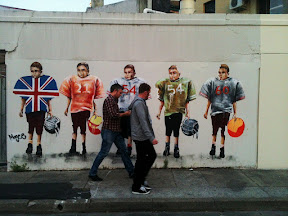
without hope you won't act.via Vivid Sydney: Shepard Fairey hits George Street with his largest ever mural by Darryn King.
Shepard Fairey on Hope and Action:
without hope you won't act.via Vivid Sydney: Shepard Fairey hits George Street with his largest ever mural by Darryn King.


Up early for a big day. Decide to go get a coffee, but the local coffee shops wont be open until 8am, so decide to go up to the coffee shop you lived in for the first six months after Jenny's passing. It was frequented many times in the subsequent years and many fond memories with family, friends and mostly, myself, in my thoughts that the place nurtured. If I could write, I could write a book about the place and what I felt and experienced there. Many of the early blog posts implicitly encapsulate this, so I am glad to have made the effort.
It is over 12 months since I have been here and when I arrived just after 7 this morning, I sat and noticed the small changes that a prolonged separation facilitates and makes so obvious. I noticed the staff. Many were the same, which says a lot for the place which becomes incredibly busy later in the day and night.
I am served by a young waiter I know by face. He has been here for as long as I can remember. We don't know each others names but we know each enough to know each other even after 12 months of not seeing or even thinking each other.
You are touched when he remembers to ask before I can say what he is just about to say "large flat white?". "Thanks, that would be perfect" I said, "you remembered". He smiled and then proceeded on his way to make sure my coffee arrived to please me as best he could.
This is the second time in a week you have experienced something like this. And you wonder how and why?
You've walked through life trying your hardest not to be noticed, for that is where a shy person finds refuge and comfort. However, it's moments like this that make you realise that you do exist and in some ways touch people. Maybe it is because you touch people by just being there in the corner, trying your hardest to not be noticed ...
"Knowing you, knowing me" as the ABBA Classic goes ..

Joel Meyerowitz writes on Ordinariness:
the ordinariness of it all made me reach for the cameravia Contadina by Joel Meyerowitz.
Saw this a mile off and I knew there was a photo amongst it all.

Iain S. Thomas on Art and Empathy:
[nice artists] create because they want to describe the world to others so that they won’t make the same mistakes or so that they’ll know what to look out for. They’re extreme empaths and if you’re extremely empathetic, you’re extremely good at communicating and art is about communicating a feelings from a thing to a person.via Intentional Dissonance by Iain S. Thomas.

Niceness is a symptom of empathy. It means you understand how someone else feels and if you understand how someone else feels, it nearly always means you care about them and if you care about them then you’re nearly always nice to them.via Intentional Dissonance by Iain S. Thomas.

Iain S. Thomas on Heart:
I am saying: risk squeezing your heart, because I believe there's goodness there, for both you and the world.Sure, maybe it'll be made of stone.
But if you squeeze it hard enough, you'll get blood
via The Risks of Never Reaching Inside Your Own Chest by Iain S. Thomas.


Sharing your dreams (*) can be scary. It can make you feel vulnerable and afraid. But if you share them with the right people, you might just get more help and support (*) than you could have hoped for. And then maybe those dreams will actually come true…via Why I gave a busker ten times more than I normally would (*) by Do What You Love (*).

I think that the most important thing that photography can do is to relate both the photographer and the viewer’s memories (*). At first sight a photograph looks straightforward as it slices off a scene or a moment in time. But the images that photography captures are actually ambiguous (*). And it’s because of this ambiguity (*) that I like photography..via Sampling in street photography (photographing other images like signs, posters and billboards) - in 35mm (*) by Alex Coghe (*) and Michael Ernest Sweet (*).


It's all those bad habits and those mistakes (*) I make that gives what I do personality.via Love Letter to Sound City (*) by Bernard Zuel (*).
When it comes to making art (*), when it comes to creativity (*), there should be no right or wrong.
As long as you have the tools, you should just go with what you feel and go with your heart.
And that's exactly what I did.




The Target
The target is the objective to be reached.
It was chosen by the archer and though it is a long way off, we cannot blame it when we fail to hit it.
In this lies the beauty of the way of the bow: you can never excuse yourself by saying that your opponent was stronger than you.
You were the one who chose the target and you are responsible for it.
The target can be larger, smaller, to the right or the left, but you always have to stand before it, respect it and bring it closer mentally.
Only when it is at the very end of your arrow should you release the bow-string.
If you view the target as the enemy, you might well hit the target, but you will not improve anything inside yourself.
You will go through life trying only to place an arrow in the centre of a piece of paper or wood, which is absolutely pointless. And when you are with other people, you will spend your time complaining that you never do anything interesting.
That is why you must choose your target, do your best to hit it, and always regard it with respect and dignity; you need to know what it means and how much effort, training and intuition was required on your part.
When you look at the target, do not concentrate on that alone, but on everything going on around it, because the arrow, when it is shot, will encounter factors you failed to take into account, like wind, weight, distance.
You must understand the target. You need to be constantly asking yourself:'If I am the target, where am I? How would it like to be hit, so as to give the archer the honour he deserves?'The target only exists if the archer exists. What justifies its existence is the desire of the archer to hit it, otherwise it would be a mere inanimate object, an insignificant piece of paper or wood.
Just as the arrow seeks the target, so the target also seeks the arrow, because it is the arrow that gives meaning to its existence; it is no longer just a piece of paper; for an archer, it is the centre of the world

Change requires a spark that ignites an individual or a team do what is necessary to achieve a goal.Another great quote found from another Daniel Coyle Google Alert that came through today (and yes I have a copy and have read Daniel Coyle's book The Talent Code - it was the first book I bought and read after Jenny's passing).
And, that spark can come from anyone at anytime.
The most effective leaders are the change agents who know how and when to light the spark that ignites a team to greatness.


Daniel Coyle writes about change when he introduces the concept of ignition in The Talent Code. Simply put, Coyle’s concept of ignition refers to the exact moment when an individual is captivated by a new idea or experience. In turn, that spark of interest crystallizes a goal and motivates action toward that goal. [..]The last paragraph reminds me of this post - What matters most is what we believe about ourselves - Alain Briot (Dec 2010).
The transformational change represented by ignition is the precursor to the "deep practice" that Coyle says is also essential for anyone who seeks to achieve excellence. For once a person is committed to a goal because he or she wholeheartedly believes in it, the work required to achieve the goal is no longer a chore but a source of fulfillment.


