
Jeffery Saddoris on A Genuine Interest:
"When you take a genuine interest in someone else .. those experiences can be meaningful, transformative and maybe even life changing"via A Genuine Interest by Jeffery Saddoris.
Jeffery Saddoris on A Genuine Interest:
"When you take a genuine interest in someone else .. those experiences can be meaningful, transformative and maybe even life changing"via A Genuine Interest by Jeffery Saddoris.

Eiffel History: Eiffel Liberty Journal (Feb 2006) at TeamEiffel
One of Eiffel's most prolific activists from the mid-90s to 2002 was Geoff Eldridge from Australia. He spent most of his spare time hanging out in places like comp.lang.eiffel spreading information to help people to use Eiffel.
After the demise of Eiffel Outlook magazine, Geoff decided that the Eiffel community still needed a magazine, but that it should be online instead of paper-based. With that in mind, he talked a dozen or so Eiffel notables into writing articles for the first issue, and he soon published it on a website at the University of Technology, Sydney.
The magazine was named "Eiffel Liberty", inspired by the fact that Gustav Eiffel had designed the framework for both the Eiffel Tower and the Statue of Liberty. The word Liberty also reflected that Geoff had visions of helping to "set Eiffel free" from the chains that were restraining it.
The first couple of issues of Eiffel Liberty were very popular, and Geoff moved them across to his newly-registered domain elj.com where he continued to publish a new issue every two months or so.
The increased webspace, and availability of scripting tools, allowed Geoff to expand the scope of the site considerably, and soon Eiffel Liberty was hosting a huge amount of content besides Eiffel Liberty Journal. Geoff's interest in Object Technology featured strongly, and as a result the site gained widespread readership beyond the Eiffel community.
As Geoff's interests broadened, he also covered scripting languages, methodology, functional programming, extreme programming, software quality and componentry. Geoff also latched on to the burgeoning interest in open source software and featured it strongly.
Despite these broadening interests, Geoff kept up the Eiffel content. He maintained GUERL, Geoff's Eiffel Resource Locator which had links to every possible resource useful to practitioners of Eiffel. In time, this overflowed into the OO Soapbox where links to other languages and technologies were featured.
As if this wasn't enough, Geoff also introduced ELJ Daily, a regular posting of the latest snippets relating to Eiffel and Object Technology. Today we'd call this a blog, but the word hadn't been invented yet. Indeed, Geoff was one of the world's first bloggers.
All this time too, Geoff was also writing open source Eiffel software and inspiring others to do the same. Talk about a powerhouse! He was also having to pay a sizeable chunk of his own cash for hosting costs and bandwidth. He never carried ads on the site.
As the site grew, Geoff and others referred to it good-naturedly by a number of alternative acronyms, including Extremely Large Jumble, which it had certainly become. It was a very useful and much-appreciated jumble nonetheless. The nickname caught on, and soon the homepage itself carried the new slogan.
But all was not well. Geoff felt that he wasn't getting much support from the Object community. He contrasted this with his other interest, photography, where he found the online communities to be highly engaging and supportive. His massive workload might have been getting him down too, and it wouldn't have helped that his girlfriend Jenny (later his wife) had cancer.
A major blow came in late 2000 after some people had strongly criticized the GUERL page as being full of disorganized rubbish. Geoff took this to heart, and erased the page, announcing that "This page has been retired ... I suppose no impression is much better than a bad impression". Many pleaded with him to restore the page, but it was not to be.
In a way, that was the beginning of the end. Although Geoff plugged away for a few more years, the zest was never there quite like it had been before, and Geoff was devoting more time to the newly-emerging hobby of digital photography. On 24 September 2002 Geoff took down the whole of elj.com.
No-one in the Eiffel community seems to know what Geoff is up to now - and quite a few of us have tried to track him down. The elj.com home page is still live, though it contains nothing more than an invitation to click through to Cetus Links. (Does Geoff realise that a three-character domain name can be sold for quite a lot these days?)
Geoff, if you're out there, why not post a comment and let us know what you're up to?
THanks for Roger Browne who wrote this. It brings back a lot of memories.


Today, 10 years on, we Remember Tim:
Timothy Francis Eldridge was born on Wednesday 4 December 1963 in Tamworth NSW. He became the third and youngest child of Thomas and Betty. He had an elder sister, Lynn, spelt with two n's not one as Tim persisted throughout his whole life). Lynn was two years older than Tim. Myself, Geoff being 3 years older was the eldest. His father was an electrical engineer with the Electricity Commision of NSW. The Regional Centre was based in Tamworth and from this office the electricity transmission system in northern NSW grew. The nature of his Father's work often required nights away from home. We all looked forward to Dad's return on Friday Night with a bag of mixed lollies for all.Lynn and I found as oursleves at school and this gave Tim two years at home with Mum by himself. Mum tells me now that he spent this time playing with the kids across the road. Even at this early age Tim was making friends. I seem to recall also that Tim managed to get a 1/2 day of pre-school (a first in the family). I always felt that this small period with other new kids gave Tim a nice head start when he commenced his schooling at South Tamworth Primary. He was well adjusted for the rigours of school, made friends easily (he was always going to birthday parties) and was a natural at anything he put his mind to.
He started in the top class in Kindy and there he stayed each year through his primary school days (and subsequent educational endeavours). Tim was a also a natural athlete and started playing rugby league at he age of eight, moving quickly onto soccer and then finally hockey (all in one year .. maybe this was a sign of things to come). He played representative hockey for Tamworth at the state champships every June Long Weekend. I even recall him playing under 12 hockey at Lismore when he was only 9. He was a prodigy even then. He also represented the North Western NSW primary school team in Murwullumbah where his team came back as state champions. Another little publicised sporting achievement was middle distance running and I remember him running a low 2 minute 800 meters at the Tamworth Primary Schools Athletic Carnival. A record that was not broken for many years.
The year Tim finished his primary school saw the Eldridge family move from Tamworth to Wagga for Dad's work. This was a tough time for everyone but we all adapted to new environs and our new high school in Wagga called Kooringal High. It was a new school and much smaller than the high school Lynn and I left in Tamworth. Probably 1/4 the size in students and was so new that it did not even have a sixth form in our first year there. Tim as always fitted in very quickily and he found new friends almost instantly. Many of whom are here today.
By the time Tim reached Wagga he had found the game of golf and before long he was swinging a set of clubs out at the Wagga Country Club, across the lake from where we lived. Here he spent many hours fine tuning his tee shots, fairway shots, chips and putts (or spits as his young nephew would subsequently refer, many years later). Golf was to become a life long passion and this was something which always stayed with him. It was only his 94 year old grandfather who thought something was wrong four weeks ago when he percieved Tim had lost interest in his Golf.
Tim breezed through high school and obtained excellent grades with little effort. In his final year he was nominated as perfect (whooops I meant "a prefect") and was voted school vice captain by his peers. For his HSC he studied a couple of hours each night on the floor in front of the TV. To recover from this strenous study regime, he would spend the next day playing 36 holes of golf.
With his HSC behind him Tim entered the University of Sydney and worked his way towards a Civil Engineering degree over a four year period. The first two years of his course, Tim lived at Wesley College, a residential college on the grounds of Sydney University. Here, Tim, along with some of high school buddies quickily adapted to the demanding University life style. Days at the beach, missing lectures, drinking beer, etc. He found new friends quickily and again many are here today. The nucleaus of this group were quickily dubbed the "DAMAGE BOYS" because of the drinking reputation at College Victory Dinners, formals and other ramdon gatherings.
Mid way through his second year, Tim's father Thomas passed away suddenly at the early age of 47 after a sunday afternoon hockey match. It was my job to tell Tim the news that Sunday night. I now remember his numb response to my news. "Where has he gone?" he asked. His fathers death at such a young age for all of us was a defining moment in Tim's life (probably the most defining moment up until last Saturday). It was a difficult time for Tim and the Family. Initially he seemed to cope well, but the next year saw Tim arrive home to Wagga unannounced many times during the university terms. I guess the one lesson (or theory actually I would call it a LAW) Tim would give us today from all this would be to grieve properly, seek support from Family, Friends and professionals and to address the difficult issues these tramatic events have on the fragile human soul.
Anyway, back to Uni, Tim bravely persisted and graduated with honours at the end of 1985. His brief but eventful civil engineering career started with a small but prestigous Civil Engineering Consultating companycalled Wargon, Chapman and Partners. Mr Wargon, a famous Amercican civil engineer appeared to take Tim under his wing and Tim quickily found himself designing car parks, and tall buildings. As well as doing one-off type jobs such as a structural integrity report of the Channel 9 Transmitter Antenna at the Channel 9 Compound, and preliminary designs for the now Sydney Harbour Tunnel.
Tim quickily realised that Civil Engineering was not for him (however a recent rush of activity with home decks shows there was some latent interest in at least some things civil). On the fifth redesign for an Alan Bond tower on the old Waltons site across from the Sydney Town Hall, Tim decided to move on. This gave him the chance to travel for 3 months overseas which took him to many places in Europe, England, particularly London and even India (if I recall correctly).
London was a place to which Tim would return frequently over the rest of his life, the last being July/August last year. The drawcards to London were friends and another life passion I have not yet mentioned, English Football. His favourite team during his schools days was Queens Park Rangers. Though his interested waned when their goalie Phil Parkes defected to my team West Ham in 1977 for a then world record sum of 565,000 pounds. Subsequent years and more recently Tim has been an Arsenal supporter.
On his return in the late 80's Tim persued his ambition for a new career. In this pursuit he found himself in Canberra studying part-time for a degree in Information Systems at the then Canberra College of Advanced Education and working part-time for small scientific software consulting firms. One system I remember was a flight simiulator program driven by data from aircraft black-box recorders.
On graduation from the CCAE Tim started work at Customs and then Department of Veterans Affairs for a record three years. Towards the end of this stint in DVA, Tim bought his house in Griffith, just up from Marnucka. He lived in the house briefly before deciding that a six month stint in Los Angles working on a Telon Related Inventory system was the go. On his return he decided to work in Sydney and here he had stints at NRMA and Westpac. Weekends saw Tim travelling back to his home in Canberra to catch up with friends and to play golf amongst other things. This became too tiring and before long he was back in Canberra fulltime working at the Australian Tax Office and subsequently Customs. His crowning software achievement was an ATO case-actioning tool which I believed was to be a distillation of systems and processes from the many places he had worked.
More recently, Tim returned to DVA where he ventured into web-based systems using packages such as Websphere and Tomcat.
Wherever Tim worked, he took the roles on seriously. He appeared to very much love a process and a set of rules to capture and implement. He believed rules were meant not to be broken (contrary to the majority of the population) and I always thought that he was perfect fit for the ATO. [He had a great sense of what was right and doing it right].
Another constant in Tim's life were his friends and I will always remember his 40th birthday speech where he said the party was not to celebrate his 40th, but more importantly, a chance for his family and friends to get together.
There is so much more to be said. We all have our memories of Tim and I ask you for just one moment to reflect on the good times you had with him ... and to take this forward with you through the tough times ahead.
It is now time to say goodbye to a loving son, brother, grandson, nephew, uncle, friend and colleague. We now know that Tim struggled with a delibertating and destructive illness which he held undercover for many years. I ask you to take the time to consider the strength he showed under this enormous pressure and to admire him for how he lived a relatively normal and happy life, shared with friends and family.
In the end Tim ran out "Puff" as he said and found peace from his illness the only way he knew how. Please forgive him. He asked for this.
Tim, you asked me where Dad had gone. We know that you searched for him high and low. We also now know that you have found him. The search and struggle is complete and that you have found your peace.
You will always have a special place in our hearts and memories. We will miss you.
Love .. Mum, Lynn and Geoff ..


Colin Pantall on Photography and Remembering:
It's strange how one remembers things without being aware on any conscious level of why one remembers or how one remembers. [..]Perhaps it might be good to reach elsewhere for our ideas on photography, outside the small, incestuous world of photo-theory so that we can add to and enrich our understanding of how images work with added engagement and added interest. Today, cognitive and social psychology might be good places to start. [..]
I can't help but feel that there is also an element of the false memory (more of which in a different post) and wish fulfilment in there as well.
The idea that when we see those happy pictures, we remember them and feel that those happy times will come again.


I find my inspiration (*) by looking for it. Anywhere.via Art Producers Speak: Joanna McClure (*) by A Photo Editor (*).
I read constantly and this helps me develop images in my head. I constantly look at art (I am not married only to photography). I watch almost every movie that comes out. I am always searching for something to highten my sense of what is possible.
The other way I find inspiration (*) is through my work. Work begets work-an idea may come through experimenting with something and this diverges into something totally different.
Often my work starts out as an interest in texture, or how two materials work together.

Simon Sinek on Change:
affecting change is the confidence and courage to simply try.via affecting change is .. by Notes to Inspire.
Still can't believe I had the courage to buy a house at 19.5% Interest Rates during the recession we had to have back in the very early 1990's. To renovate it 23 years later was the bravest and most courageous thing I have ever done. As well as the best. It took three years to go from a thought to reality. It has given a 108 year old house a new lease of life and it has changed my life. The impact of the courage to affect the necessary changes will out live me. It will be my legacy to the world.

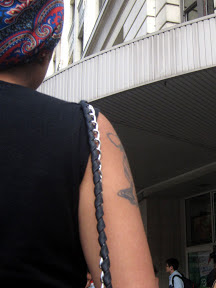
In Photography we must not always tell all. The ambiguity (*), the unsaid, the mysterious gives the image interest and arouses the imagination of the observer.via Learn from Daido Moriyama (*) by Alex Coghe (*).


Make the most from the leastvia Penelope Seidler maintains interest in architecture, arts (*) by Nicole Elphick (*).

Brooklyn Bridge on ramp foreground, Dumbo and East River middle ground, Manhattan Bridge background and the Empire State Building distant background.... and the zig-zagging nature of the key elements that lead you through the photo. And besides some weathered yellow and a little bit of orange never goes astray.


During this time, I was trying to make photographs about the 'all of it'; pictures without a central subject. I wanted all the information, near and far, to hold our interest equally, and I wanted colour to be an intricate part of the content. I was trying to unlock photography from the aesthetic of the decisive moment - a difficult thing to give up.A great book to have.


I really like the last inscription.Remember that neither riches nor fame, beauty nor age can save you from death, that takes all
(On the south side of the fishpond)
Remember what will come after
(On the north side of the fishpond)
Know thou what thou art then why art thou proud?
(On the lavatory wall)

Tokyo, the 50'sI bought this book following this Review (*) by Jesse Freeman (*). The preface is one of the most amazing pieces of writing on photography I have read, and I have read a lot. A beautiful book, both in words and photos, and I am so glad I took the risk to buy it on a whim.
When I First Roamed the Streets
by Ikko Narahara (*)
Photographs arrive suddenly from out of the future. For it me it was always like that. Suddenly I would reach out and grab it in midair - the photographs had appeared by itself in my hand. Whenever I pushed the shutter button, my body seemed to become transparent, as if it were out int the middle of the photograph. And as I continuted to take photographs over the years, I came to feel that the images I took had already buried in matrixes of some sort in the space of the future, where they remainded waiting for the moment when I would one day dig them up. That must surely have been how it was. From that time of the big bang with which the universe started and began its evolution, perhaps even though the will of the universe latent in the fluctuations in the "nothing" preceding the big bang, these experiences had surely been prepared for. I am simply a messenger sent to meet up with the images and rescue them. This is the only way I can reconcile myself to the strangeness and mystery of having brought so many photographs into the world.
Possessed by thoughts like these day after day, I suddenly remembered I'd forgotten something - the photographs I had taken when I first began roaming the streets.
I bought my first camera in 1954. I got it to use for my planned work., "Human Life". At the time I couldn't have imagined that after exhibiting that work my whole life would change course toward photography and toward the person I am today. In the intervals between photographing "Human Land" I used to walk the Tokyo streets with my camera. I didn't have any special or clear purpose in mind. My family had often moved to different locations in western Japan, and since I was a child I'd had the habit of thoroughly exploring each new location. I felt the same interest in my exploring Tokyo, whereI'd lived since I came there as a college student. The only difference was that now I carried a camera with me. I breathed photographs on Tokyo street corners the way I breathed air. In my viewfinder those street corners changed into "streets in my photographs." Whenever I released the shutter, I seemed to hear the beat of modern jazz, which I loved so much. I remember I kept on rambling the streets in this way until I became involved in taking my next work, "Domain" in 1958. I was so lazy that I only printed a few of these photographs. The negatives lay buried their negative case, where I forgot about them. By chance, however, I remembered these negatives from forty years earlier. For the past three years I have again been photographing in the streets of Tokyo, and this brought back the memory of my earlier roamings.
"I'd really to see them .. I wonder what photos I took back then?" I couldn't even remember most of the images, and very few of the contact prints remained. But the moment I realized I wanted to see them, I was overcome with the strange feeling of being faced with the all too obvious and simple fact that photographs have to be printed in order to be viewed. After all these years I'd become thoroughly accustomed to the life of taking photographs, and yet here I was suddenly realizing that all too easily I'd vaguely assumed that once I'd pushed the shutter the things I'd taken simply continued to exist by themselves. But even for me, they were actually nothing more than events lying latent in my mind. As mere negatives there were like inverted ghosts; they had to no reality as photographs. I was shocked to realize that those negatives still lacked real existence, and then I had to laugh at my own blindness.
Before long, from what seemed to be the negatives, I made new contact prints and began to look through them.
As I put them into the enlarge, I could hardly wait to see how they would turn out. Unrecognizable images of which I had almost no memory began to appear before my eyes. Were these really my photographs? The photographs came into being like starlight arriving from forty light years away.
Past time buried in the time of the future - a sleeping time with with its eyes suddenly wide open. Through this small astonishment I was also tasting the strangeness and wonder of photographs. As that time my darkroom was filled with the paradoxes of time travel.
I've come to see that these photographs, which excavated the light and wind of the 1950's, were unmistakably the first steps in my travels through cities which would turn into the rest of my life. [..]

[..] when I think about my photographs, I understand that my interest all along has not been in identifying a singular thing, but in photographing the relationship between things.Thanks Joel and congratulations on a fantastic career in your chosen profession.
The unspoken relationship, the tacit relationship, the impending relationship.
All of these variables are there if you chose to see in this, in this way.
But if you chose to only make objects out of singular things you wind shooting the arrow into the bullseye all the time and you get copies of objects in space.
I did not want copies of objects.
I wanted the ephemeral connections between unrelated things to vibrate.
And if my pictures work at all, at their best they are suggesting these tenuous relationships.
And that fragility is what so human about them.
And I think it's what's also in the romantic tradition, because it is a form of humanism that says we are all part of this together.
I am not just a selector of objects.
And there's plenty of photographers here who are great photographers but who only work in the object reality frame of reference.
They collect things and I don't think of myself as a collector.
It's my sense of where I am different from other people and that's not a measure or judgement.
It's just a sense of your own identity.
For me the play is always in the potential - it's like magnetism.
