Showing posts sorted by relevance for query Photography. Sort by date Show all posts

Friday, March 22, 2013

On Photography - The Rise in the Art World - Carol Vogel (Thu 21 Mar 2013)

A Little Peek - George Street / Sydney (Thu 14 Mar 2013)

Carol Vogel (*) writes On Photography (*) and it's rise in the Art World:
photography has changed drastically over the years, becoming more and more ingrained in everyday life through the Internet and Photoshop, smartphones and devices like iPads.
via The Lens Rises in Stature (*) by Carol Vogel (*).

Lots of interesting quotes in this article, which is a kind of milestone article for photography. Here are a few of the quotes I liked ..

Joel Smith (*) observes:
Now everyone’s a photographer, [..] It’s part of the language of what we do. All you have to do is walk down the street. And with Facebook or Tumblr there are infinite possibilities. But museums should be devoted to the original thing. That will continue to give the public a reason to see what’s here.
Julian Cox (*):
There’s a hungry audience of people who want to see photography shows”
and he adds, the reason for photography’s popularity is simple:
It’s accessible.”
Quentin Bajac (*) notes a new direction in Photography Curation:
I’m thinking of photography within a far broader context - with film and painting, architecture and drawing - making connections that show it to be equal in status with all the arts.
Katherine Bussard (*) concludes:
It’s an interesting moment, [..] Earlier generations were struggling to have photography taken seriously. We’re way past that now.

Wednesday, August 4, 2010

Favourite Photos - How much beauty in decay! - Hyde Park/Sydney - Dec 2001

Leaf - How much beauty in decay! - Hyde Park/Sydney - Wed 27 Dec 2001 (picasa)

A photo I took after work during the Christmas New Year period of 2001. Fires were burning all round Sydney and the sky was covered in smoke which resulted in a strange orange colour which can be seen in this photo. At the time I was reading much about photography and various photographers. This particular photo was inspired by Eliot Porter.

Eliot Porter was a photographer I found early on in my photography journey and self-education. It was easy to appreciate his work (google). He was a pioneer of colour photography (more here) and his life work was bequested to the Amon Carter Museum in 1990 shortly before he died (NYT Orbituary).

Not sure how I found him, but his name seems to appear whenever landscape photographers start talking about Colour Landscape Photography when compared to Black and White Landscape Photography, particularly that of Ansel Adams (looking at the size of the wikipedia entries, it is easy to see who was more popular both as a photographer and selection of photographic technique).

Found some interesting information about him searching the web (google). Also, found some of his books (along with those of Australia's own Peter Dombrovskis) in the National Library of Australia and would often take a look at them in NLA's reading rooms when in Canberra. Many of his photos resonated with my own vision and definitely influenced me when taking landscape (even streetscape and travel) photos, particularly in the Snow Mountains.

At the UNSW I found the book Eliot Porter: photographs and text (a great article) by Eliot Porter. Learnt a lot from the text and photos selected for the book. The following is a quote (see my photo.net page) from the book, which helped form my photographic vision ..
"It is the beauty of nature that I try to represent by photography. What this expression means to most people, I am quite sure, is such features as flowers of spring, autumn foliage, mountain landscapes, and many other similar aspects about aesthetic qualities of which no one would care to offer contradiction. That they are beautiful is indisputable, but they are not all that is beautiful about nature; in fact they are only the obvious and superficial aspects of nature - which anyone may observe with half and eye. They are the peaks and summits of nature's greatest displays. There is no doubt about their importance; they could not be dispensed with. Underlying and supporting these brillant displays are slow, quiet processes that pass almost unnoticed from season to season, unnoticed by those that think that beauty in natures is all its gaudy displays.

Much is missed if we have eyes only for the bright colors. Nature should be viewed without distinction. All her processes and evolutions are beautiful or ugly to the unbiased and indiscriminating observer. She makes no choice herself; everything that happens has equal significance. Nothing can dispensed with. This is a common mistake that many people make; they think that half of nature can be destroyed - the uncomfortable half - while still retaining the acceptable and the pleasing side; their idea is a paradise where nature stands still. Withering flowers blooming, death follows growth, decay follows death, and life follows decay - in a wonderful, complicated, endless web the beauties of which are manifest to a point of view attached to vulgar restricting concepts of what constitutes beauty in nature. Thoreau, who observerd all aspects of nature throughout his life, repeatedly remarked on the beauty of the unaccepted. 'How much beauty in decay!' he exclaimed on examining a worm-eaten leaf. To him the sere, brown leaves of winter were as beautiful as the fresh green of spring. This was a principle that has remained important for me throughout my career."
A fairly long quote, but for me was definitely something worth remembering.

This link provides a great summary of the life and works of Eliot Porter. I like the ending quote ..

The final paragraphs on the art of photography touch on his views to color, composition and emotional content of his images:
"Sensitivity cannot be faked by trickor devise; it has no substitute, and any attempt to replace it with mechancial contrivances is certain to be apparent to the more discerning critics. Not all photographs have to be inspired to be worth making, but the best, rare photographs are the result of a a force at least very close to inspiration. Formulized work becomes impersonal, an all the individuality of authorship tends to disappear. It unquestionably has its uses, but it is not art."
The book itself echoes Porter's ability to redact nature's chaos into a single harmonious image, and is a well-deserved tribute to this pioneer of color nature photography.


The following was one of my favourite Eliot Porter photos:

Pool in a Brook, Brook Pond/New Hampshire by Eliot Porter - 04 Oct 1953 (Carter Museum)

I recently thought of Eliot Porter and the above photo, when I took the following photo during the 2010 Ord River Marathon:

Ord River Reflections - 2010 Ord River Marathon - Sun 14 Jun 2010

Friday, June 1, 2012

On Street Photography - Kaushal Parikh / Alex Coghe Street Photographer (Thu 31 May 2012)

Smile (1 of 2) - Pier 83 / 42nd Street / New York (Sat 13 Aug 2011)

Kaushal Parikh (*) On Street Photography:
Street Photography I feel is now the most challenging genre of photography.

Most photographers if sent to the Himalayas are likely to return with some spectacular images, but put photographers on a city street and the resulting images will most likely fail to inspire.

Capturing special moments in ordinary circumstances is not easy which is why we see an abundance of average street work online.

Technology and software are less important in a street photographers pursuit of the decisive moment.

Ten years from now new street photography styles may emerge but I hope there are as many photographers roaming the streets and documenting the evolution of life and society.
From an Interview with Kaushal Parikh from Indian Street Photography Collective-Thats Life (*) at Alex Coghe / Street Photography (*)

Smile (2 of 2) - Circle Line Ferry / Hudson River / New York (Sat 13 Aug 2011)

Tuesday, March 19, 2013

On Photography - Memories and Ambiguity - Daido Moriyama

Martin Luther King Jr (*) Mural (1 of 2) - Chicago (Tue 06 Sep 2011)

Daido Moriyama (*) writes On Photography (*):
I think that the most important thing that photography can do is to relate both the photographer and the viewer’s memories (*). At first sight a photograph looks straightforward as it slices off a scene or a moment in time. But the images that photography captures are actually ambiguous (*). And it’s because of this ambiguity (*) that I like photography..
via Sampling in street photography (photographing other images like signs, posters and billboards) - in 35mm (*) by Alex Coghe (*) and Michael Ernest Sweet (*).

Martin Luther King Jr (*) Mural (2 of 2) - Chicago (Tue 06 Sep 2011)

Sunday, December 27, 2015

On Photography and Life - Eric Kim (Sun 27 Dec 2015)

Eric Kim - UNSW / Kensington (Fri 20 Apr 2012)

Eric Kim on Life:

Never forget where you Came From [..]

And never forget to always love yourself
via Photography is Escapism by Eric Kim.

Had the pleasure of hearing Eric talk back April 2012. Quite the philosopher and I always enjoy reading his posts and many a quote has found its way here, today being another.

What I have found about photography is that is a reflection on and of Life. The beauty of the act of photography and thinking of photography.

On photography as a form of escapism. It is perfect, because sometimes that is what need to get through. And for me, along with the paddling, that is how it has been and will continue to be I suspect And there is nothing the matter with that.

Jo, Eric Kim and Geoff - Jo's holdout - UNSW / Kensington (Fri 20 Apr 2012)

Friday, November 19, 2010

Annie Leibovitz - Sydney Morning Herald (Nov 2010)

The Annie Leibovitz exhibition Annie Leibovitz: A Photographer’s Life 1990–2005 has just opened at Sydney's Museum of Contemporary Art. Here are three articles that have featured in the Sydney Morning Herald over the last two weeks.

Annie Leibovitz - Spectrum (Cover) / Sydney Morning Herald - 06 Nov 2010

A life in Photography by Robert McFarlane - Spectrum (Page 6) / Sydney Morning Herald - Sat 06 Nov 2010

A life in Photography by Robert McFarlane - Spectrum (Page 7) / Sydney Morning Herald - Sat 06 Nov 2010

Life and death, put into perspective by Joyce Morgan - Sydney Morning Herald - Wed 17 Nov 2010 (Article)

Annie Leibovitz - The Diary - Sydney Morning Herald - 19 Nov 2010

Also see Beyond the flashing bulbs of fame by Andrew Taylor (Sun 14 Nov 2010) ..

Leibovitz's disdain for celebrity is reflected in "Annie Leibovitz: A Photographer's Life 1990-2005", which opens at the Museum of Contemporary Art on Friday.

Just a third of the exhibition features the high-profile names that have turned Leibovitz into a celebrity. There are more images of family and friends and 40 photos include documentary shots of lives ruined by war in the former Yugoslavia and Rwanda.

MCA's director Liz Ann Macgregor said these were her favourite works: "Two of these unforgettable images achieve their strength by showing what is not there – in the absence of victims, we see only the aftermath of war and the bloodshed left behind."

In contrast, Leibovitz said the intimate shots of her parents on the beach and brother and father posing bare-chested, arms crossed, were her "most important work".

"It tells the best story, and I care about it. You don't get the opportunity to do this kind of work except with people who you love: people who will put up with you."


I have enjoyed seeing the personal side of Leibovitz's work and will definitely go to the exhibition.

Have a copy of Susan Sontag's (Leibovitz's Lover) Monograph On Photography which I bought in Canberra in 2002. It seemed an odd relationship because of Sontag's views on photography. I could empathise with their situation with Sontag's journey with Breast Cancer and I remember following the news of Sontag's final weeks and then reading Sontag's New York Times Obituary.

Like all professional photographers, there is definitely a private side to Leibovitz's Photography and I am sure most photographers like myself want to see the private side.

I look forward to viewing the exhibition. I saw the exhibition's book a few years ago. What I really look forward to, though, is the Landscape Photograph work which will feature in future book titled Pilgrimage.

Wednesday, May 6, 2015

On Photography and Intention – StreetShooter (Mon 06 May 2015)

Heart - Ultimo (Fri 20 Mar 2015)

StreetShooter writes on Photography and Intent:

Here’s some things I discovered and figured out. I am not claiming to be the inventor or Doctor of Photography. I am just a guy that’s made photography a very important of my existence and these are things I try to live by.

There are 3 facets to photography. Eye, Heart and Mind. The Important thing is INTENT. Try to visualize a Pie. In the center is INTENT. Equally at three points are Eye, Heart and Mind. There are 3 parts because Intent is why you do things and not how you do things. The other 3 are how you do things.

All parts are the sum of one and effect each other at different times.

via Streetshooter … Thoughts and Findings … Defining and Finding “Intent” by StreetShooter.

Friday, June 27, 2014

The Power of Photography - Kim Weston / Maurice Berger (Fri 27 Jun 2014)

Untitled - Pitshanger (*) Lane / Ealing (*) / London (Sat 17 Aug 2013)

Kim Weston (*) writes Photography (*) and Love (*):
Coming so close to dying made me realize that life is short, and that I had a choice, [..] I wasn’t doing what I loved, and I was determined to go after my dream (*).
So It was suggested:
Go back to doing what you love (*). Photography (*) makes you smile (*).
And so she did:
Photography has opened so many doors for me. I often wonder where my life would have gone if I had not had the privilege to experience its power. I know it saved me.
via What the Camera Sees, and Doesn’t See (*) by Maurice Berger (*).

The power of photography to heal the broken (*) and fractured (*), demonstrated yet again (*).

Thursday, April 23, 2015

The Give and Take Miralce of Life and Photography - StreetShooter (Thu 23 Apr 2015)

Street Shooter - "[son] Mummy. What is he taking a photo of? [Mum] Go take a look when he is gone." - Fremantle (Sun 19 Apr 2015)

StreetShooter on Photography and Life:

all the sudden it occurred to me that everything in the universe has the ability to teach and to learn. So even on the streets making photos the energy you receive is equal to the energy you send. So your intent is to make photos but ya know, you aren’t in it alone. [..] If life is a give and take miracle then it stands to reason that photography is also. So that means that we think we are the origin of our work but that’s not true. We are not alone in life.

Our photographs and I am only talking about photography, are a collaboration between life and ourselves. We hope for and strive to find a synergism with the street and make the photos that represent that synergism. We can not rightfully state that we are the Origin of our work. [..]

If you are like every reader that ever was or ever will be on this blog [streetshoot.net], then you are aware that you don’t take any photographs, you collaborate wit Mother Light and The Street and you make your photos.

Tomorrow is another day and if I wake and am healthy, I’m hitting the streets. I hear tell Life is out there and I’m gonna look for it.

via Philly Street … Thoughts With … Olympus Pen EP-5 by StreetShooter.

Sunday, June 7, 2015

On Portrait Photography - Richard Johnstone (Fri 29 May 2015)

Photos - Alexandria (Sun 07 Jun 2015)

Richard Johnstone on Portrait Photography:

One of the great mysteries of portrait photography hinges on whether we can successfully read character and biography into a single image.

via Face time - Photography | Richard Johnstone reviews the finalists in this year’s Head On Portrait Prize by Richard Johnstone.

I think the portrait of Jenny captures her character perfectly. I had an A4 print made of it shortly after I took it on Christmas Day in 2006. Joanne bought a nice frame for it and we placed on her Coffin at her Funeral. What better photo to celebrate and reflect on her life.

Thursday, April 25, 2013

On Photography - Rebecca Norris Webb and Alex Webb (Tue 16 Apr 2013)

Untitled - George Street / Sydney (Apr 2013)

Rebecca Norris Webb advises:
Learn to listen to your photographs. They are often wiser than you are.
While Alex Webb (*) advises:
Follow your passion (*). You should pursue photography (*) because it is something you love - that you absolutely need to do. The rewards from photography - recognition, occasional remuneration - are so fleeting that it makes no sense to pursue photography (*) except as a labor of love.
5 frågor till: Alex Webb & Rebecca Norris Webb (*) by fotografiska (*).

Wednesday, October 21, 2015

On Photography and Memories - Streetshooter (Wed 21 Oct 2015)

Jenny and Geoff - I remember it being very hot - Prague (Wed 30 Aug 2005)

Streetshooter on Photography and Memories:

Photography is one of the seductive means of making memories. So I wonder why many aren’t aware that they are making memories. [..]

What’s really going on is that you are making memories and maybe just maybe those photos will have importance to someone. [..]

[during the Vietnam War] I became acutely aware that photography is about memories. It’s about other shit too, but memories are the main source of image information transference.[..]

See, they are not just my memories. [..] All will be forgotten of the pain that still hurts 45 years later.

the photos, well… they are just memories…………..

via Streets of Philadelphia … A Visual Diary … Page 25 … Street … Memories of Future Past … Fuji X100s by Streetshooter.

The very reason I bought a small digital camera in Dec 2000. And just as important as recording memories, you need to make the memories happen. You have to live while you can. And we did just that. Thanks Jenny and Jo.

Thursday, December 13, 2012

Mark Cohen - Street Photography (YouTube)

Mark Cohen - Street Photography [Youtube (*)]

A bit of a preamble to this but it is worth the wait in order to see his working method on the street and the ensuing interview of which there are many great quotes On Photography (*). I have scribbled a few down here:
[..] They are snapshots and they are made in a very simple way. But the thing they see when they continue to look at the pictures, they start to see the closeness is one of the things they see. Some one is making pictures that are really close on the street and its that kind of taking the camera so close to the subject and making pictures and not in a studio way. in a flow of life on the street or field kind of way. And they see that closeness and that is the thing that gives the pictures there uniqueness and their agressive sort of character.

When you make an exhibit of this work, you walk around in a room filled with it and you see all these strange pictures. You know there is a certain excitement to it, There is a certain quality in that room about an artists mind, and an artists work that comes from the pictures and touches the viewer in some way. That's why it works. I don't know why exactly it works. A lot of physcological reasons, sexual reasons. A lot of things are going on in those pictures.

It is not some kind of exact analytical science going on here, its right on the edge of meaninglessness, but its in there and that is what makes it so fascinating.

It feels awkward for me to try to talk about my work, frequently. Once in a while I do it. I do a slide show and I describe how I take the pictures. Describe how I think they fit into things socially and formally, in the context of photography in America. Different kind of things.

You usually don't think about that kind of stuff. You dont think about that. You think about when you are taking pictures the most important thing is to get new pictures.

The pictures you already took, you already took those pictures. My main drive is to do something new. To make some new kind of picture. [..]
A copy of Grim Street (*) is on the way.

Monday, October 29, 2012

On Remembering - Daido Moriyama

Shinjuku Lights - Shinjuku / Tokyo (Mon 17 Sep 2012)

Daido Moriyama (*) at Rabbit Hole Tumblr (*)
I think that the most important thing that photography can do is to relate both the photographer and the viewer’s memories.
For me and my ever failing memory, this is exactly what is the beauty of photography. While I am failing to remember names and the little details that make life easier in the connected world I engage in, I can remember my feelings and memories. Photography helps but, oddly enough, I also have a photographic-like memory for my feelings and scenes that catch my eye.

I can look at any one of my 100,000 digital photos that I have taken over the last 12 years and tell you where it was taken, why I took it and what I was feeling at the time. Amazing really. Thank you photography, I am a better person because of you.

Thursday, October 9, 2014

On Street Photography - Steven Rosen and Brian Sholis (Wed 08 Oct 2014)

SMASH THEIR CAMERAS - Newtown (Aug 2014)

Steven Rosen (*) writes Street Photography (*):
The mid-20th century was when street photography became well known, thanks to photographers like Henri Cartier-Bresson, Garry Winogrand and others. Armed with unobtrusive hand-held cameras, they rapidly snapped pictures of passersby, searching for unstudied compositions [..]
Brian Sholis (*) continues:
In the 21st century, for better or worse, there are fewer people at home during the day and we’ve offloaded a lot of that ‘eyes on the street’ to surveillance cameras,
Steven Rosen (*) summarises:
At the same time, those cameras fill many with unease.

So 21st century street photographers are dealing with techniques and issues far different from their forebears
Brian Sholis (*) concludes:
What unites them is they’re incredibly attentive and able to reveal things that we might not otherwise see because the street is such a kinetic and dynamic place
via Street Photography in the 21st Century (*) by Steven Rosen (*).

Street Portrait (*) - Piccadilly Ciricus / London (Fri 12 Sep 2014)

Wednesday, September 18, 2013

On Street Photography - Chris Farling (Tue 17 Sep 2013)


Chris Farling (*) writes On Street Photography (*):
in general I think Street Photography (*) work should primarily convey the artistic sensibility and personality of its author.
from which Chris expands:
There’s something confessional and diaristic at the heart of Street Photography (*), hidden as it may be through a layer of visual abstraction. Also, I think that the process of navigating the ethical terrain that every street photographer must deal with is one that helps you mature as a person.
via Observe Collective Interview #2: Chris Farling (*) by Eric Kim (*).

Friday, December 17, 2010

Geoff Dyer on Trent Parke (2010) - American Suburb X - (Fri 17 Dec 2010)

Geoff Dyer on Trent Parke (2010) - American Suburb X - (Fri 17 Dec 2010)

I have a Google Alert for Trent Parke, an Australian Photographer who is a member of Magnum and in-public (who BTW have just celebrated their 10th birthday).

Trent Parke - Google Blog Search Result - My Google Reader - Fri 17 Dec 2010

Most days I will get one or two alerts come through on my Google Reader. Normally, they don't lead to anything interesting or something I don't already know about him. However, I received an alert that quickly drew my attention. It was titled:

Geoff Dyer on Trent Parke (2010).

As Andrew Bruce posted today on Trent's Facebook Wall:

easily the best piece of writing on Parke to date

Have to agree and it is definitely worth a read.

A bit of a ramble to follow. I have known of Geoff Dyer for sometime. At least since around the time of the publication of his book, the The Ongoing Moment (Guardian Review - 16 Oct 2005). A novel and rather modest approach to writing about photography - he claims that he does not even own a camera:

"I am not a photographer ... I don't even own a camera."

I enjoyed the book and appreciated his knowledge of photography. In particular I enjoyed his writing style and the metaphors he used to get his ideas across - you will see this in his article on Trent.

[on writing about the book, The Seventh Wave] The surface of the sea is a film separating two worlds, that of water and that of air. Though absolute the distinction is perpetually on the brink of dissolving, melting away. People fly through the water as if suspended in a turbulent sky, or float through great clouds of aquatic light. That’s what water is for Parke and Autio – liquid light. Forms dissolve, blur, swim into and out of focus. Quick and silver, the water is a flash-flood of mercury.

Phot from the The Seventh Wave - Narelle Autio and Trent Parke

On to Trent Parke. I have followed his progress since he was photographer with the Sydney Morning Herald back in the early 2000's. He had two photos in the first Sydney Looking Forward Exhibtion back in 2002. I wrote about one of the photos here. Indeed the post is one of the more popular pages residing in my little blog.

In 2003 I bought two copies of the two books he had published at that stage:
Both books appear to be long out of print, by the looks of the Amazon Used Books prices.

Looks like I have done alright with these purchases (they were about $50 each from the Stills Gallery). I could not help myself other than to buy two copies of each. They were just beautiful. I have a soft/weak spot for photography books. I can remember catching the train after work, upto Kings Cross and then walking into Paddington to the Stills Gallery. I took quite a few photos with my litte IXUS. Must drag them out of the archive to find out the exact date of purchase of the books. A job for another day.

I will close with a quote from Geoff Dyer's article on Trent:

Later works will continue but intensify the Dream/Life vision so that, at its most extreme, Sydney becomes a kind of ghost city, in the process of being annihilated by light. A passer-by will be transformed into an accidental super-hero: Solar-man, a bleached absence of pure radiance! (Part of the fascination of this picture is of the photographer-as-magician kind: how did he do that? The difference between magic and photography is that the spell remains unbroken even when the technical explanation - which, in any case, I cannot recall - is forthcoming. [GeoffE: maybe some discussion here will help: How is this done? (Trent Parke) at photo.net - 31 Mar 2004)]

White Man, 2001 - Circular Quay/Sydney (GeoffE: at guess!) - Trent Parke

An article by the Sydney Morning Herald's Tim Clayton giving some background to the working environment that Trent Parke evolved.

Saturday, July 9, 2016

Street Photography - Jesse Marlow / Ray Edgar (Sat 09 Jul 2016)

street portrait - "A Little Bit of Red" - Broadway / Sydney (Sat 02 Jul 2016)

Jesse Marlow on Street Photography:

The essence of street photography is that it won't be the same in an hour's time .. It's about developing a style
via Has Instagram changed photography forever? CCP's birthday brings the present into focus by Ray Edgar.

Maybe I have developed my own style on the street? Something I will explore more with time.

Tuesday, May 31, 2011

Things forbidden us by the quickness of the moment, and the social constraint against looking ..

On Street Photography - TR Smith (Online Photographer - Tue 10 May 2011) ..
the most interesting images would likely come from breaking commonplace social conventions, and going where people do not often go, looking where people do not often look. [..]

that consists of paying attention to things that we generally pass by without looking at closely.

Things forbidden us by the quickness of the moment, and the social constraint against looking.
Random Recollection: We sat quietly on some steps in front of a large hall in Central Brussels to rest our legs and to watch the crowd pass by.

It was easy to spot the lady in the pink dress holding a can of beer - Brussels being the home of beer to many.

She circled rather randomly in front of us and then sat beside us. Unknowing to her, I snapped the following sequence of photos, which to me seem to capture some of the sentiments from the above quote.

Street Photography #1 - Brussels / Belgium (Wed 09 Sep 2009)

Street Photography #2 - Brussels / Belgium (Wed 09 Sep 2009)


Street Photography #3 - Brussels / Belgium (Wed 09 Sep 2009)

Wednesday, January 2, 2013

On Photography - Diligence and Balance - Kirk Tuck (Tue 01 Jan 2013)

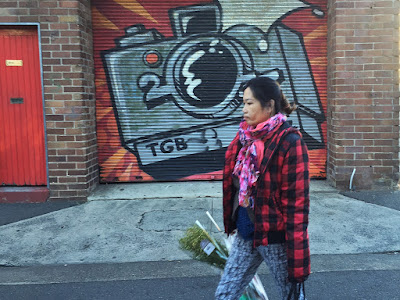
Street Art Portrait #1 - Phillip St / Enmore (Sat 15 Dec 2014)

Kirk Tuck (*) writes On Photography (*):
[..] you have to be diligent. There has to be a balance.

Thank God we invented photography.

It gives us a ready and reliable excuse to push away from our desks, easy chairs, dining room tables and couches in order to head outside and get some creative thinking and seeing done.

A photography secret for living longer and happier lives.
via Good light is what you miss if you spend too much time indoors (*).

Street Art Portrait #2 - Phillip St / Enmore (Sat 15 Dec 2014)