Showing posts sorted by relevance for query preparation. Sort by date Show all posts

Wednesday, June 22, 2011

Emotional Preparation For The Olympic Games by Cal Botterill

Emotional Preparation For The Olympic Games by Cal Botterill

A great article and one worth reading. Here are some random points ..
Being clear minded should be an important objective going into the Games [Championships]. Once again though, it is critical to feel focused and occupied and to avoid falling into the human tendency to start overanalyzing. It has been suggested that "nothing never happens"; in the absence of a constructive focus our minds sometimes start "over-thinking" or "over-perceiving."
  • Enjoy the emotional spectrum that is part of life.


  • Accept and experience feelings, let them go, and channel the energy into growth and effective responses.


  • Respect the power and positive and negative significance of emotions on your system.


  • Manage relationships and time so that you do not become emotionally drained at key times in your life, especially when working hard physically and mentally.


  • Let go of irrational beliefs and perspectives.


  • Reaffirm your mission, values, and perspective.


  • Live. Never have to say, "I wish I would have ..."

An athlete should be confident in mental skills going into the Games [Championships]. Responses to stress and boredom should automatically be constructive, and time and relationship skills should be crisp and effective. Creative simulations, quality training sessions, and lead-up competitions can help ensure the rust is off attention and competitive skills during the countdown.
He concludes with the following:
I would say to each of our Olympic athletes: Walk away knowing you gave it your best shot and exulted in the opportunity to test yourself in one of the most prestigious and emotional environments in the world. Accept that you can never totally control your emotions that is part of the challenge of being human. With emotional preparation, practice, and management we can often come closer to our situational potential.

Compete with passion, perspective, and preparation and be all you can be as you pursue your Olympic destiny. I wish you physical prowess, a clear mind, and an unburdened heart. Citius, Altius, Fortius! [The Olympic Motto]
Definitely worth a read. Take from it what you can for your own mental preparation.

PD's Mixed Team Pre-race Team Huddle - 2011 Nationals - Canberra (Fri 01 Apr 2011)

Willy and George - Pre-race Preparation/Rituals - Senior A Mixed 500m Final - Racice /Prague (Sat 29 Aug 2009)


Some Down Time - Chinese New Year - Darling Harbour / Sydney (Sat 06 Feb 2009)

Turning it on - World Club Crews - Penang / Malaysia (Sat 02 Aug 2008)

Thursday, May 19, 2011

Thoughts on Being the Best by Vernon Gambetta (11 Nov 2008)

Thoughts on Being the Best by Coach Vernon Gambetta (11 Nov 2008). A repost to get this to come up on the Tampa 2011 Label. It is also worth having a look at some of the other posts I have collected here.

Control what you can, not what you can’t! Be Smart. Work on something specific each day. Have a plan! Train with a purpose. Improvement is incremental. Small steps lead to big steps.
  • Pressure - Pressure is what you make it! Use the pressure to make you better, internalize it and use it as a positive influence.


  • Belief – Think you are the best and you are on your way. Confidence, believe in yourself, your preparation and your support system.


  • Routine – Great athletes doing the same thing, the same way, at the same time each day. Regularity. You can set a clock by the great ones.


  • Work - Every one works. The great ones work smarter. Analyze your strengths and weaknesses objectively. Minimize your weaknesses and optimize your strengths. Bring your weaknesses up to the level of your strengths.


  • Choices - It is always about choices. Make the choice to be the best. Life is constantly about choices.


  • Improvement - Michael Jordan, as good as he was, got better every year he played! He would pick one aspect of his game each off-season and set out to improve that aspect with relentless determination.


  • Perfection - The perfect game has yet to be played, in fact it will probably never be played. The perfect race has yet to be run. That does not mean we should not strive for perfection, it does mean that that we should strive for perfection but not be frustrated when we do not achieve perfection. Take chances, risk, try a new move in a game, take on a defender. Make things happen!


  • Mental Toughness - Physical preparation gives mental strength. Push yourself, do not give in. Go the extra step and the extra mile.


  • Effort - Performance may vary, but effort is a constant. You have control over your effort. Make it high energy, high level and purposeful. Consistent effort will level out the peaks and valleys in performance.


  • Goals - It is about goal achievement not goal setting. Anyone can set goals, but few can achieve goals! Dreams are private. Goals are public. Share them. Find people to support you to achieve your goals. Be specific both in setting your goals and the means to achievement. Constantly visualize yourself achieving your goals!


  • Focus - No rabbit ears! Program your inner voice to respond only to what you tell it. Only listen to your positive self-talk. Filter out the negatives.


  • Evaluation - Self-assessment is a constant for those who chose to be great. Be objective. Look at the positives and the negatives. It is an ongoing process. Evaluation and self-assessment are a series of stepping-stones necessary to climb the staircase of success.
Be yourself and true to yourself. You are great and will get better!


A copy of a blog post that I always come back to. Learnt a lot from this and all of Vern's writing.

Geoff an Jim Farintosh Canadian Senior Mixed/Open Coach and Sweep - Racice Prague - Fri 29 Aug 2009

Always take the time to say hello to Jim Farintosh from Toronto. First met him at Sydney 2007 when he coached and swept the Canadian Senior Open and Mixed Teams. Next said hello in Penang in Aug 2008 where he coached and swept the Toronto area "Mayfair Predators". Decided in Prague to finally get a photo with him after the Senior Open's 200m medal presentation. A top coach and a person who is obviously highly regarded by his peers.

Thursday, July 26, 2012

On Thanks: A Reward for the Experience - Drew Ginn (Wed 25 Jul 2012)

Boat - Portland Street / Mong Kok / Hong Kong (Mon 09 Jul 2012)

Two days before the London Olympics start, Drew Ginn (*) writes some thank you's. He notes (*):
thanks should not come because of a result or particular place it comes as a reward for the experience
Well said Drew and obviously many thanks to you for sharing your experiences and knowledge so openly and articulately. There is a great book in the making from you blogging over the last 5 years, of which I have been there since April 2007 (wow, it has been that long).

All that is left now is the final preparation (*) and then the racing. As one my own coaches does not believe in the the phrase Good Luck, I will leave you with this (*) from Super Coach Vern Gambetta (*):
[..] you have done the preparation [..] you are in control and you have given yourself a chance. [..] it is not the hand of fate that will touch you rather it is your fate that is in your hands.
Still, I can't help myself, by saying all the best and good luck.

Tuesday, March 15, 2011

Game-day performance is a manifestation of training and preparation - Phil Gould (14 Mar 2011)

Game-day performance is a manifestation of training and preparation.

It is a test of attitude and the ability to control your attitude under the pressure of challenge.


Timely advice from Phil Gould (Thanks to Steve for finding this quote).

Pacific Dragons Premier Women 500m Team - 2009 Australian Dragon Boat Championships - Kawana / Qld (Fri 24 Apr 2009)

Pacific Dragons Premier Open 500m Team - 2009 Australian Dragon Boat Championships - Kawana / Qld (Fri 24 Apr 2009)

Tuesday, August 10, 2010

Thoughts on Being the Best by Vernon Gambetta (11 Nov 2008)

Thoughts on Being the Best by Coach Vernon Gambetta (11 Nov 2008).

Control what you can, not what you can’t! Be Smart. Work on something specific each day. Have a plan! Train with a purpose. Improvement is incremental. Small steps lead to big steps.

Pressure - Pressure is what you make it! Use the pressure to make you better, internalize it and use it as a positive influence.

Belief – Think you are the best and you are on your way. Confidence, believe in yourself, your preparation and your support system.

Routine – Great athletes doing the same thing, the same way, at the same time each day. Regularity. You can set a clock by the great ones.

Work - Every one works. The great ones work smarter. Analyze your strengths and weaknesses objectively. Minimize your weaknesses and optimize your strengths. Bring your weaknesses up to the level of your strengths.

Choices - It is always about choices. Make the choice to be the best. Life is constantly about choices.

Improvement - Michael Jordan, as good as he was, got better every year he played! He would pick one aspect of his game each off-season and set out to improve that aspect with relentless determination.

Perfection - The perfect game has yet to be played, in fact it will probably never be played. The perfect race has yet to be run. That does not mean we should not strive for perfection, it does mean that that we should strive for perfection but not be frustrated when we do not achieve perfection. Take chances, risk, try a new move in a game, take on a defender. Make things happen!

Mental Toughness - Physical preparation gives mental strength. Push yourself, do not give in. Go the extra step and the extra mile.

Effort - Performance may vary, but effort is a constant. You have control over your effort. Make it high energy, high level and purposeful. Consistent effort will level out the peaks and valleys in performance.

Goals - It is about goal achievement not goal setting. Anyone can set goals, but few can achieve goals! Dreams are private. Goals are public. Share them. Find people to support you to achieve your goals. Be specific both in setting your goals and the means to achievement. Constantly visualize yourself achieving your goals!

Focus - No rabbit ears! Program your inner voice to respond only to what you tell it. Only listen to your positive self-talk. Filter out the negatives.

Evaluation - Self-assessment is a constant for those who chose to be great. Be objective. Look at the positives and the negatives. It is an ongoing process. Evaluation and self-assessment are a series of stepping-stones necessary to climb the staircase of success.

Be yourself and true to yourself. You are great and will get better!


A copy of a blog post that I always come back to. Learnt a lot from this and all of Vern's writing.

Geoff an Jim Farintosh Canadian Senior Mixed/Open Coach and Sweep - Racice Prague - Fri 29 Aug 2009

Always take the time to say hello to Jim Farintosh from Toronto. First met him at Sydney 2007 when he coached and swept the Canadian Senior Open and Mixed Teams. Next said hello in Penang in Aug 2008 where he coached and swept the Toronto area "Mayfair Predators". Decided in Prague to finally get a photo with him after the Senior Open's 200m medal presentation. A top coach and a person who is obviously highly regarded by his peers.

Tuesday, February 28, 2012

Preparation, Fate and Chance - Vern Gambetta (Mon 27 Feb 2012)

Hop On, Hop Off Bus - Red - Battery Park / New York (Thu 11 Aug 2011)

From Vern Gambetta's 1000th Post on Typepad (*) ..
If you have done the preparation then you are in control and you have given yourself a chance.

If you want to be ready look at how you are preparing.

Are you preparing or just hoping that luck and fate will favor you?

It doesn’t work that way, it is not the hand of fate that will touch you rather it is your fate that is in your hands.
I remember when Vern went over to Typepad and I really can't be believe I have been reading his words of wisdom and inspiration for that long. Congratulations and thank you Vern.

Friday, November 23, 2012

On Colour - Mental Preparation - Brad McGee / Cycling Tips (Thu 22 Nov 2012)

Red and Blue - Erskineville Road / Erskineville (Fri 23 Nov 2012)

Brad McGee (*) talks (*) about the depth and extent of his mental preparation:
If I needed firing up on the way to the start line, I’d look for cues like red colours, if I felt I needed calming down I’d look for blue…
via Brad McGee: Stealing that Time Back... (*) at Cycling Tips (*).

Monday, June 18, 2012

On Succeeding - Drew Ginn (Mon 18 Jun 2012)

Boats - Cambridge / UK (Thu 03 Sep 2009)

Drew Ginn (*) abstracts the following On Succeeding from yesterday's win (*) in Munich..
To succeed [..] we sort of need to want it less. To care but care less. To push but push less and to create without trying hard.
As he indicates ..
.. this sound stupid but its [..] the complete opposite [that] is need[ed] to achieve what's desired.
I know exactly what he writes about. It does not make sense, but it does in so many ways.

Drew, good luck to you and your crew for your final preparation and assault on London 2012.

Wednesday, October 3, 2012

Adam van Koeverden - Interview / YouTube (Szeged 2011)

Adam van Koeverden - Interview / Youtube (*) (Szeged 2011)

Great interview with a great athlete who is a role model to many. He gets better as he gets older and as he says, he has few years of competing yet. Look forward to seeing what he does next.

Szeged is where the 2013 IDBF World Dragon Boat Champships will be held in late July 2013. I hope to be there one way or another and the preparation has already started. Follow the Adam van Koeverden below for some more inspiring posts.

Thursday, July 31, 2014

On Performance - Drew Ginn (Fri 12 Jun 2009)

Water (*) - Hvar / Hvar / Croatia (Wed 31 Jul 2013)

Drew Ginn (*) writes on Performance (*):
preparation (*), connection (*) and release (*). It seems to me the simple cycle of what we do in the boat [/and Life in general]. [..]
Drew then expands on the concept of release (*):
Release and get excited I like because no matter what happens we have the power (*) and capacity (*) to see (*) and respond (*) to our experiences (*) in a way that best serves us and those around us.
And finally::
it is fascinating to think about how our mind set (*), emotions (*) and the manifestation play out physically.

[..it's] what matters most and [..] learning (*) to keep it at the surface of awareness can have a huge impact on performance (*).
via What's on the RADAR (*) by Drew Ginn (*).

Friday, March 2, 2012

On Failure - Some Notes on Photographic Intent - Ground Glass / Spencer Lum (01 Mar 2012)

Mont-Royal Red - Mont-Royal / Montreal (Thu 18 Aug 2011)

Ground Glass / Spencer Lum (*) writes (*):
Failure is the sound of a thousand wasted efforts screaming in unison. [..]

So the goal [..] should be to use those things that inspire us as a framework for exploration, so we can learn the process behind them.

Shots aren’t preordained.

They are happy accidents, lead by intention, and founded on a combination of preparation and discovery.

In other words, photography isn’t seeing the big picture.

It’s knowing how to stumble from one adjustment to the next, eliminating choices along the way, while focusing on others, until we find that one thing that says just what we want. [..]

Success is the sound of a single action made of a thousand efforts.

Saturday, August 16, 2014

Is first place the only way to get to where you're going? - Seth Godin (Fri 15 Aug 2014)

National Champions (photo taken by Jenny) - and sometimes when you least expect it, you do come first!! - Geoff (*) - 2006 AusDBF National Dragon Boat Champs - Nagambie (*) (Sun 16 April 2006)

From yesterdays post (*), Seth Godin (*) asks:
Is first place the only way to get to where you're going?
A very good question.

And I know of one response (*) through experience (*).

More specifically, from an earlier post (*)..
Julia Ryall (*) writes On Performance (*) and Expectation (*) amongst other things:
Performance (*) is not about crossing the line first, it is about having great plan, the right preparation (*), the ability to execute the plan (*) well on the day, realistic expectations (*) and an ability to celebrate (*) the performance rather than the placing.
via PDdb - DB Paddling Update: The ultimate performance is a greater reward than first place by Julia Ryall (*).

Written, what now seems so long ago, but still so right and relevant. Almost six years on, and so many amazing experiences (*) in between, these words makes much more sense now than they did back then.
And even more so now. Thanks Julia.

Thursday, May 19, 2011

Being the Best – Take Action Now by Vern Gambetta (Wed 06 Oct 2010)

Vern follows up on his post Thoughts on being the Best (11 Nov 2011) with the following:

Being the Best – Take Action Now (Wed 06 Oct 2010) ..

  • Be Smart - Work on something specific each day. Have a plan! Train with a purpose. Improvement is incremental. Does not have to be big. Small steps lead to big steps.

    ACTION: ...


  • Pressure is what you make it! Embrace it. Put yourself in pressure situations to learn. Use the pressure to make you better, internalize it and use it as a positive influence.

    ACTION: ...


  • Belief – If you don’t believe in yourself who will? Think you are the best and you are on your way. Confidence, believe in yourself, your preparation and in your support system.

    ACTION: ...


  • Routine – Great athletes do the same thing, the same way, at the same time each day. Regularity. You can set a clock by the routines of the great ones.

    ACTION: ...


  • Work - Everyone works. The great ones work smarter with a sense of purpose. Analyze your strengths and weaknesses objectively. Then work to minimize your weaknesses and optimize your strengths. Bring your weaknesses up to the level of your strengths.

    ACTION: ...


  • Choices - It is always about choices. Make the conscious choice to be the best. Life is constantly about choices.

    ACTION: ...

Without ACTION these are all just words. Take ACTION now!


He expands with the following:

In bold are the qualities with an explanation, but those are just qualities. Underneath each item you see the word ACTION. [..] Over the years I have learned it is too easy to set goals or to talk about being the best, unless those goals are followed up by specific actions it just is a very temporary feel good process. Each individual needs to take control and decide on the they action they will take. They must establish ownership. Do not recommend or assign an action for them.


As always, Vern has a great blog and it is always worth following his posts.


Jenny two weeks after liver resection - ERG Practice - Bank Street / Sydney (Sun 03 Jun 2007)

Jenny two weeks after liver resection - ERG Practice - Bank Street / Sydney (Sun 03 Jun 2007)

Jo ready to crack 400m for 2min - ERG Practice - Bank Street / Sydney (Sun 03 Jun 2007)

Joanne, Geoff and Jenny - Masters Men and Womens 500m Silver Medalists - IDBF World Championships / Sydney 2007 (Sun 23 Sep 2007)

Sunday, July 3, 2011

Coaches & Coaching: The Art Form - Drew Ginn (Tue 24 Jun 2008)

Another Favourite Blog Post by Drew Ginn. This time about coaches and coaching titled Coaches & Coaching: The Art Form (Tue 24 Jun 2008) ..

[..] From directing, to coaching, to supporting and delegating. It's important to understand that coaches need to be adaptable and flexible in the style to best suit the athlete and the situation.

From what I have been exposed to over the years I have had coaches who have all been different and at certain times they have suited my needs and other time they have not quiet matched up to what I have needed. This has also played out in relation to the situation also.

Recently our coach, Chris worked on being more directed and coaching in his style. After we got back into things it was required that he shift his focus to suit our situation. It was a different energy and help us greatly in getting the ball rolling again. We have been good at working with him in a more supportive and delegating way which relates to our experience and willingness to be involve and responsible for our preparation and performance.

Years ago with the four, Noel Donaldson was great at managing the group and as such operated well in a supportive capacity. This did not mean at times he didn't shift into directing the group and coaching but it was often a quick switch and very effective in getting a response.

Now when I think of my development years at times I need a good kick up the ass. And well I had a few good coaches that did it perfectly. My only concern with this style of directing is that at some point the emphasis needs to shift and if it doesn't then problems and or confusion can grow.

In Australia right now we have a large variety of coaches with such a range of experiences and history in the sport. I am sure there is a different level of ambition and ego too. Surely they are no different to the athletes in one sense. They want to be the best they can be. They want to be the best. They I would have thought would want what is best for their athletes. Some times these two things can be in conflict which to me is the coaching dilemma.

This [leads] me to consider what it can be like in a crew also. In fact it goes to the heart of teamwork and why it can be so challenging to get it right. In a boat you want to do the best you can. You also want the team to do it best. You want everyone one to do there best. The dilemma then is what is the priority then? What are you measure by? What drives what and what can bring it all undone? These question like the coaches dilemma are very important in understanding why some times things work and other times they don't.

At this level everyone has ability and everyone has performed in a way to get to where they are. There fine line between wanting something for your self and wanting something for others is a fickle and often precarious position. You need to be motivated to be the best, but this need has to stay in check with relation to the motivation for the collective effort.

I mention all this because coaching like rowing is about balancing the influences, expectations and needs of all involved. Although the coaching view of things is some what objective if this is all that is focused on then the nature of the art form is lost in the numbers. The subtlety of shifting and adapting is needed with out being reactionary. A coaches view is often more comprehensive. They have to take in more information about performance on and off the water. This is the challenge and to honor all perspective is critical.

Coaches like athlete need to be masters of their art form to have longevity. When I say master I refer to the ability to stay even in their presence and maintain consistency while subtly shifting focus based on what the situation requires.

As an athlete I know I need a coach. I enjoy having a person who I can work with to enable the best outcome. I have been fortunate to have what I would say as some of the great coached from our sport. Noel and Chris have been a major factor in me getting this far and assisting in helping me to not only be a better athlete but better person.

This I am sure is not unique to me, I am sure many athletes have and will continue to feel this way about their coaches.


Lots to think about in this one.

Wednesday, April 23, 2014

On Performance - Julia Ryall / PDdb (Tue 04 Nov 2008)

Pacific Dragons - 500m Premier Mixed Final - 2014 AusDBF Dragon Boat Nationals - Kawana (Sat 19 Apr 2014)

Julia Ryall (*) writes On Performance (*) and Expectation (*) amongst other things:
Performance (*) is not about crossing the line first, it is about having great plan, the right preparation (*), the ability to execute the plan (*) well on the day, realistic expectations (*) and an ability to celebrate (*) the performance rather than the placing.
via PDdb - DB Paddling Update: The ultimate performance is a greater reward than first place by Julia Ryall (*).

Written, what now seems so long ago, but still so right and relevant. Almost six years on, and so many amazing experiences (*) in between, these words makes much more sense now than they did back then.

Thursday, August 30, 2012

Where all the Good Stuff Happens - Spencer Lum (Tue 28 Aug 2012)

Last Training Session - Sydney 2012 Auroras - Bank St / Pyrmont (Sun 26 Aug 2012)

Spencer Lum (*) observes (*) that:
The 90% point is deceptive. It feels like you’re nearly there. But you’re really just getting started. And if you don’t make the big push right then and there, you’re not doing the things you need to do to learn what you are really all about. It’s in the final 10% that all the good stuff happens.
A Big Thank You to all the Sydney based 2012 Auroras. The training is now done here in Sydney, though the journey continues and the final push starts - Brisbane this weekend and Busan (*) / South Korea the following week. Enjoy the final phases of preparation.

I hope you find all the Good Stuff that comes with the sacrifices made and risks taken to get to this point.

Last Training Session - Sydney 2012 Auroras - Blackwattle Bay (Sun 26 Aug 2012)

Tuesday, September 11, 2012

On Belief - Vern Gambetta (Tue 11 Nov 2008)

Joanne and Geoff - 2012 Pacific Dragons Auroras
Day 2 / 500m / 10th Asian Dragon Boat Championships
Centum / Busan (Sat 08 Sep 2012)

Vern Gambetta (*) writes (*) on Belief:
Belief - If you don’t believe in yourself who will?

Think you are the best and you are on your way.

Confidence, believe in yourself, your preparation and in your support system.
Sat 08 Sep 2012, the light shone (*) on the 2012 Auroras.

Congratulations to all 2012 Auroras representing Australia at the 10th Asian Dragon Boat Championships in Busan, South Korea. I hope your experience and the amazing results achieved will give you confidence and strength to continue on with your endeavours in paddling and life.

A hugh thank you to Joanne who keeps me pointing in the right direction when the going gets tough. Joanne you are a legend.

500m Mixed 12 - Bronze Podium - Centum / Busan (Sat 08 Sep 2012)

500m Mixed 20 - Bronze Podium - Centum / Busan (Sat 08 Sep 2012)

500m Open 12 - Bronze Podium - Centum / Busan (Sat 08 Sep 2012)

500m Women 20 - Bronze Podium - Centum / Busan (Sat 08 Sep 2012)

Monday, September 6, 2010

Full Capacity by Drew Ginn (23 May 2007)

Full Capacity by Drew Ginn (23 May 2007)

[..] It is amazing to put everything into a single stroke.

So when I refer to full capacity I know it can relate to fatigue but on this occasion it was about maximum force.

It was as if I was producing peak force every stroke and what becomes noticeable is when I cam off the boil just slightly.

The difference between sitting on 1.34 and 1.35 is so fine and yet full capacity is in reality maybe not sustainable.

So what I was playing with was going to full capacity and then staying aware of how I was producing that force.

Relaxation and breathing were key and speed of movement was critical.

Once I started to find I began working hard it was like being presented with a choice. A fork in the road, with one option being to muscle it and try to work harder and harder or the other was to relax into it and trust that by keeping the intention of speed, relaxation and by using a strong breathing rhythm.

Well a couple of times I went down the path to option one and a few times down the path to option two. The result was clear to sustain the output and ease of drive was actually possible with the later.

So stepping up to full capacity is one element in the equation to optimal performance, the other being the ability to sustain the intensity.

It was a great little test and I will keep in mind during our preparation for the Worlds this year.


Another Favourite Blog Post from Drew Ginn.

A nice follow on from the previous post - One Stroke (29 Apr 2008) by Drew.

Dragons Abreast Sydney (DAS) - Full Capacity - CNY 2005 - Feb 2005


Dragons Abreast Sydney (DAS) - Full Capacity - Woronora Regatta - Dec 2004

Monday, May 23, 2011

Winning the Workout by Vern Gambetta (Thu 18 Nov 2010)

Winning the Workout by Vern Gambetta (Thu 18 Nov 2010)

The above is a short video Vern put up on Youtube on 18 Nov 2010. He talks about the importance of Winning the Workout, a term he first heard at a conference.

He expands upon Winning the Workout here.

Some more background from the following post ..

Win the Workout by Vern Gambetta (01 Sep 2006)

I must admit when I first heard Wayne Goldsmith, an Australian sports scientist, speak about this I was a bit put off.

My thought was how can focus on winning the workout and still have something left for competition?

The more I thought about it the more sense it made.

Before I can ever think about winning in competition I must win the workouts consistently.

It is a mindset that each athlete must bring to every training session.

It is a convergence of psychology and physiology that accumulates over time.

An athlete who is confident in their preparation is an athlete who has a chance in competition.

To win the workout it must meet the following criteria:
  • The workout must be completed with concentration on the task at hand.


  • The workout must be done with the effort required, nothing less. This should be a given.


  • The workout must be done with intensity. Effort does not equal intensity


  • The drills and exercises must be done precision and quality


  • Finally the athlete has to be accountable for their performance during training.

Wednesday, November 3, 2010

HCC 2010 Team Vela - Preparation

In preparing for the 2010 Hawkesbury Canoe Classic (2010 HCC) I looked at how we might be able to utilise GPS technology to assist us during the course of the paddle. I have a Locosys BT-31 (*) and a Garmin Forerunner 301.

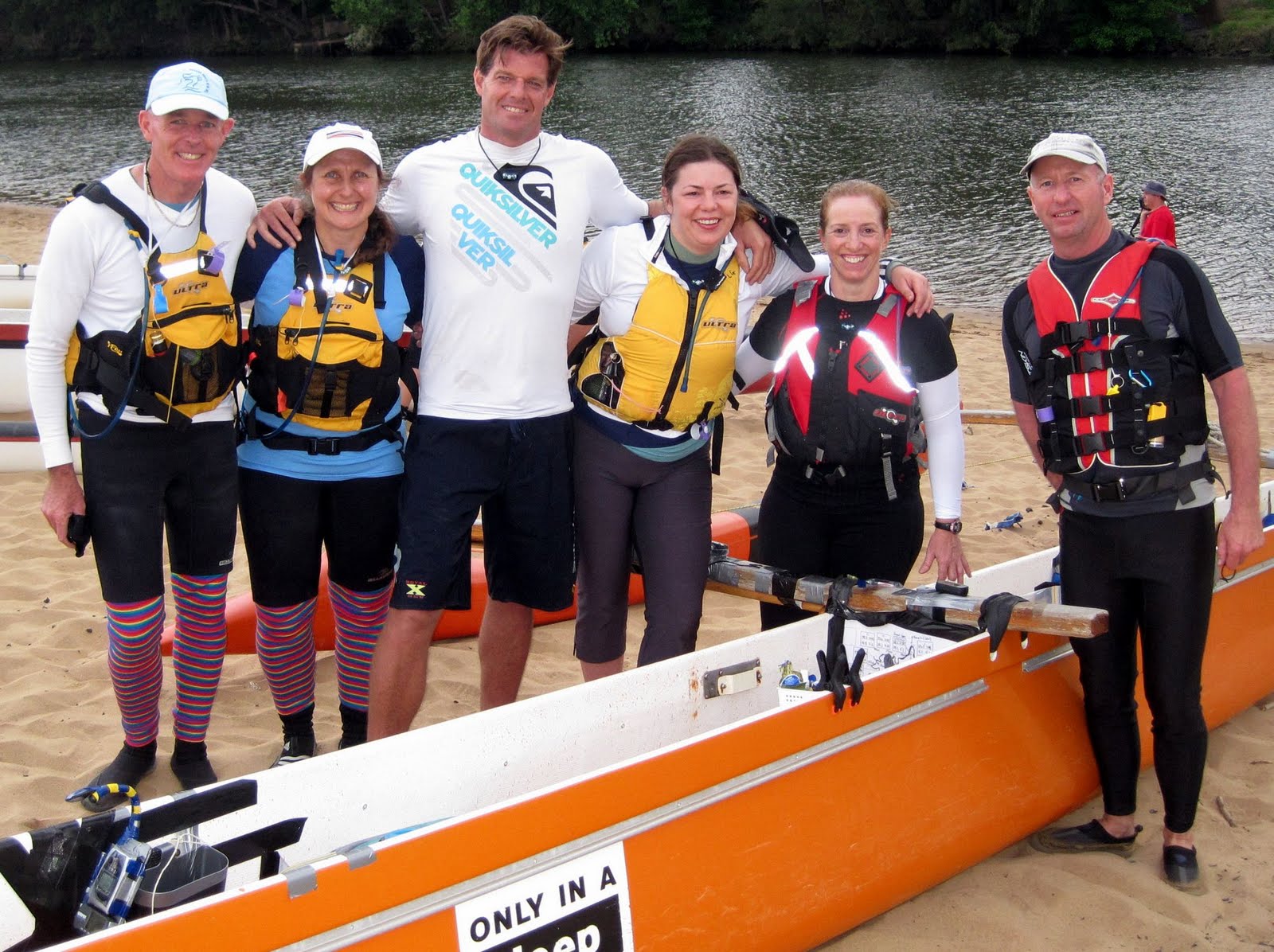
Team Vela - Geoff Eldridge, Jo Petterson, Alasdair Grant, Charlotte Pache, Rachel Mosen and Graeme Bacon - Windsor - Sat 23 Oct 2010 (picasa)

The Locosys GT-31 has navigatiion capability where a course can be entered into the GPS and that the course can be tracked by following a directional bearing provided by the GPS.

The first step was to work out how to create and load a course into the Locosys GT-31. After a little bit of goolging, the following links proved useful:

It was decided that we should have our pit stops at Sackville and Wisemans (Dargyle near Checkpoint E is now not used as Pit Stop), so our attempt would be split the HCC into three sections. Namely:

  1. Sect 1 - Windsor to Sackville (29.2 km)


  2. Sect 2 - Sackville to Wisemans (29.3 km)


  3. Sect 3 - Wisemans to Brooklyn (40.3 km)
The course was then plotted on gmap-pedometer.com for each of the three sections of the HCC:

The resulting gmap-pedometer.com maps (see screenshots below) can be zoomed in/out and panned to follow the course in great detail. Hopefully, this demonstrates the kind of lines to follow in order to minimize the distance covered (however tide and weed have an impact on following other lines). Navigation can be done pretty much by sight in the full moon. There may be fog and dark spots along the course, so it is always helpful to know where we are.

Sect 1 - Start to Sackville (29.2 km - gmap / trkpt gpx)

Sect 2 - Sackville to Wiseman’s (29.3 km - gmap / trkpt gpx)

Sect 3 - Wiseman’s to Finish (40.6 km - gmap / trkpt gpx)

After some data massaging (a long post in itself - email for details at present), the resulting section files were uploaded into the Locosys GPS. The Garmin Forerunner 301 would be used as a backup for data recording purposes.

The next step was to come up with some kind of arrangement to see the GPS, particularly at night, where as a steerer, I did not have the opportunity to switch on the GPS Backlight. A booklight was suggested and an arrangement was planned for and put together on the day (see the following photo). The GPS can be seen in the bottom left corner of the Team Vela photo at the top of this post:

GPS Setup for Locosys and Garmin GPS's - Windsor (23 Oct 2010)

Having paddled the 2007 HCC, I had a GPS Result file which I could use to provide some estimates for arrival times at our pit stops at Sackville and Wisemans, to assist our great landcrew in preparing for our arrival.

One thing I found from the 2007 GPS Output, was that the distance travelled was 99.3km, which approximately 10% lower than the 111km length, the HCC has become famous. I also had a file with the Checkpoint GPS Cordinates (provided from the HCC website). These two files allowed calculation of the distances between each checkpoint so that a better estimate could be made of arrival times.

The other factor determining estimated arrival times was the tide. The HCC Organisers provided a Tide Chart and I plotted various arrival time lines (10, 11 and 12 hr) to determine where the tides would change. See the 2010 Tide Chart below, for more details:

HCC 2010 - Tide Chart with 12hr (Red),11hr (Blue) and 10hr (Green) finish times - Sat/Sun 23/24 Oct 2010 (pdf)

With all this information in hand, the following table was constructed:

HCC 2010 - Progress Chart - 2007 Times - Tide Estimate - 10km/hr Estimate

The Tide Estimate details were transferred onto an ammended HCC Progress Chart (see below). A laminated copy was available in the OC6 for the paddle.

HCC 2010 - Progress Chart based on Tide Estimate - Sat/Sun 23/24 Oct 2010

It was nice to be prepared and I will write up later how it all went on the night.